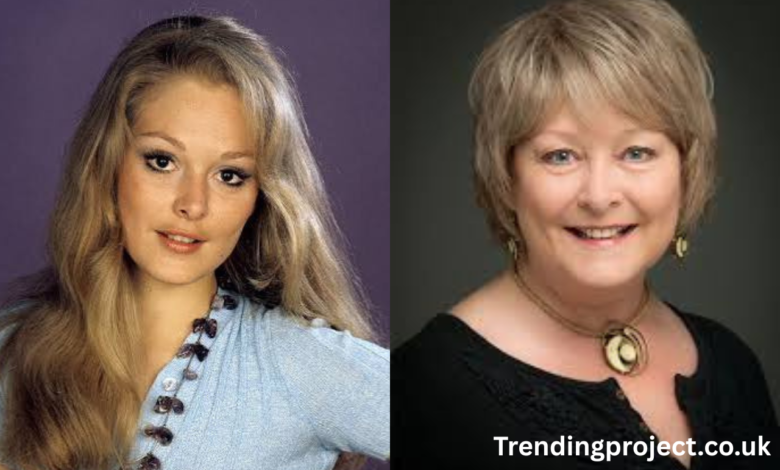
Jenny Hanley’s career is a fascinating journey through several generations of British entertainment. Long before the age of social media celebrities and instant online fame, she built a reputation through acting, television presenting and radio broadcasting, becoming a familiar face to millions of British viewers. She appeared in the James Bond film On Her Majesty’s Secret Service, worked with the legendary Hammer horror studio in Scars of Dracula, and eventually became one of the best-known presenters associated with ITV’s much-loved children’s programme Magpie. Decades later, she remains connected to broadcasting through Boom Light, where her distinctive voice continues to reach audiences who remember her from television as well as listeners discovering her work for the first time.
Born on August 15, 1947, in Gerrards Cross, Buckinghamshire, England, Jenny Hanley grew up in an environment unusually close to the entertainment industry. Her parents were actors Dinah Sheridan and Jimmy Hanley, meaning that performance and show business were already part of her family world. However, her own career was not simply an extension of her parents’ achievements. She developed her own professional identity, first through modelling and acting and later through television and radio presenting. Her ability to move successfully between these different forms of entertainment became one of the defining characteristics of her professional life.
What makes Jenny Hanley’s biography especially compelling is the longevity and variety of her work. Some performers become permanently associated with one role, while others gradually disappear from the public eye after their most successful period. Hanley followed a different path. She continued developing professionally after her film years, became strongly associated with children’s television during the 1970s, hosted other television programmes, worked in radio and eventually found another long-running broadcasting home with Boom Radio and Boom Light. Her story is therefore not simply about fame in the past; it is also about reinvention, adaptability and maintaining a connection with audiences over decades.
Jenny Hanley Quick Facts
| Fact | Details |
|---|---|
| Full name | Jenny Hanley |
| Date of birth | August 15, 1947 |
| Age | 79 years old in 2026 |
| Birthplace | Gerrards Cross, Buckinghamshire, England |
| Nationality | British |
| Profession | Actress, television presenter, radio presenter |
| Years active | 1968–present |
| Parents | Dinah Sheridan and Jimmy Hanley |
| Sibling | Sir Jeremy Hanley |
| Best known for | Magpie, On Her Majesty’s Secret Service, Scars of Dracula |
| Former husband | Herbie Clark |
| Children | Two sons |
| Current radio work | Boom Light |
| Boom Light schedule | Friday–Sunday, 12 noon–2 p.m. |
| Estimated net worth | Not reliably publicly documented |
| No reliably verified official account identified | |
| X/Twitter | No reliably verified official account identified |
| No reliably verified official account identified |
Early Life and Family Background
Jenny Hanley was born into a family with deep connections to British entertainment. Her mother, Dinah Sheridan, was an established actress whose career included film, television and theatre, while her father, Jimmy Hanley, was also an actor and presenter. Growing up with two parents who understood the demands of performance would have given Hanley an unusual early insight into the entertainment business. The world of auditions, rehearsals, publicity and professional discipline was not completely unfamiliar territory to her.
Her family background was broader than her parents’ careers alone. Hanley’s brother is Sir Jeremy Hanley, who went into politics rather than entertainment and eventually became a Conservative Party chairman and government minister. This contrast between the siblings is an interesting part of the family story: while Jenny established herself in film and television, Jeremy built a career in public service and politics. Their different professional paths demonstrate that growing up in a prominent family did not determine a single direction for either child.
Hanley’s wider family history also connected her with British photography and celebrity culture. Her grandmother was a photographer who worked under the professional name Studio Lisa and was associated with photographs of members of the royal family. According to biographical accounts, she also played a role in the early modelling career of Roger Moore, who later became internationally famous as James Bond. This connection is particularly intriguing given that Hanley herself would eventually appear in a Bond film.
Education and Her First Steps Toward Entertainment
Hanley was educated at schools in southern England and Switzerland before entering working life. Her education took place during a period when British society was changing rapidly, particularly for young women seeking professional opportunities outside traditional career paths. Rather than immediately becoming an established actress, Hanley explored different forms of work and eventually trained as a nanny before moving into modelling.
Her modelling experience provided an important introduction to the professional world of fashion and photography. During the 1960s, modelling could act as a gateway into advertising, film and television because performers were frequently recruited through photographic and fashion networks. Hanley’s move from modelling toward acting therefore followed a path that was relatively natural for someone with her appearance, confidence and family exposure to the entertainment industry.
The transition nevertheless required more than family connections. Establishing a lasting career meant developing professional experience and proving that she could work effectively in front of cameras. Hanley gradually accumulated those opportunities, and by the end of the 1960s she was appearing in films and becoming part of the rapidly expanding British television and cinema landscape. Her first professional years laid the foundation for the much broader career that followed.
Jenny Hanley’s Film Career Begins
Jenny Hanley’s film career developed during one of the most recognisable periods in British cinema. The late 1960s and early 1970s produced major international franchises, distinctive British horror films and a wide variety of comedies and dramas. Hanley appeared in several productions during this period, giving her an early filmography that remains interesting to fans of classic British cinema.
One of the most significant entries in that filmography was On Her Majesty’s Secret Service, the 1969 James Bond film starring George Lazenby as 007. Hanley appeared as the Irish Girl. Although the role was not one of the film’s central characters, being part of a major Bond production gave her an association with one of the most successful and recognisable film franchises in cinematic history.
The Bond appearance also became an enduring part of her public biography. Decades after the film’s release, biographies and entertainment databases still identify the production among her best-known screen credits. For an actress at the beginning of her career, working on such a high-profile international film was a valuable professional experience and helped establish her place in British screen entertainment.
Working With Hammer Horror
Hanley’s film career continued with Scars of Dracula, released in 1970. The movie was part of Hammer Film Productions’ famous Dracula series and starred Christopher Lee as Count Dracula. Hanley played Sarah Framsen, giving her a prominent connection to the British horror tradition for which Hammer became internationally celebrated.
Hammer horror occupies a distinctive position in British cinema history. The studio became famous for its atmospheric productions, Gothic settings and recurring collaborations with performers such as Christopher Lee and Peter Cushing. Appearing in a Hammer production therefore placed Hanley within a particularly recognisable strand of British genre filmmaking. Her work in Scars of Dracula continues to attract interest from classic horror fans.
The film also demonstrated the range of Hanley’s early screen career. Her work was not limited to glamorous or mainstream productions. She could appear in a major international spy franchise and then move into Gothic horror, while other credits from the same era included comedy and drama. This variety helped create a filmography that remains more diverse than the single-role image sometimes associated with performers of her generation.
Other Notable Film Roles
Beyond Bond and Hammer horror, Hanley appeared in several other films during the early 1970s. Her credits include The Private Life of Sherlock Holmes, Danny Jones, The Flesh and Blood Show, Soft Beds, Hard Battles, Percy’s Progress and Alfie Darling. These projects placed her alongside a range of established British performers and filmmakers.
The Flesh and Blood Show, released in 1972, is particularly interesting because it was made as a 3D horror-comedy production. Hanley played Julia Dawson in the film. The production belongs to a fascinating period in British cinema when filmmakers were experimenting with formats and spectacle to attract audiences to cinemas at a time when television was becoming increasingly influential.
Her early filmography consequently gives researchers and classic-cinema fans a useful snapshot of British entertainment during a period of rapid change. Hanley was working when traditional studio filmmaking was evolving, television was expanding its cultural influence and genre cinema was experimenting with new techniques. Her film roles formed an important first chapter, but television would ultimately become even more significant to her public identity.
Becoming a Magpie Presenter
Jenny Hanley’s biggest breakthrough with British television audiences came through Magpie. The ITV children’s magazine programme ran from 1968 until 1980 and was designed as a lively alternative to BBC children’s programming. Hanley became one of its recognisable presenters during the programme’s later years, appearing from 1974 to 1980.
For Hanley, Magpie represented a major shift from acting toward television presenting. Instead of performing a scripted character, she had to communicate directly with viewers, introduce features, interview guests and maintain an energetic presence throughout the programme. This required a different set of skills, particularly the ability to appear natural and spontaneous while working within the structure of a live or tightly produced television format.
Her association with Magpie eventually became stronger than many of her film credits. Boom Radio describes her as being fondly known for her appearances on the 1970s children’s programme, demonstrating how strongly the show remains connected with her public identity. For viewers who grew up watching ITV during that period, Hanley was not simply an actress who occasionally appeared on television; she became a familiar part of their childhood television experience.
Life After Magpie
When Magpie ended in 1980, Hanley did not simply disappear from television. Instead, she continued accepting presenting and acting opportunities. Her television credits include appearances in programmes such as Department S, The Persuaders!, The Adventurer, Softly, Softly: Task Force, Warship, Man About the House and Return of the Saint.
One notable opportunity came with Saturday Night at the Mill. Hanley stepped in to co-present an edition of the programme in 1980, and the appearance was successful enough for her to return as co-host for the 1981 season. The episode illustrates an important feature of her career: she was capable of adapting to different television environments rather than relying solely on the identity she had developed through Magpie.
She also continued appearing in entertainment and quiz programming. Her television career gradually became less about one signature programme and more about versatility. This ability to move between children’s television, mainstream entertainment, acting and presenting helped her maintain a professional identity during a period when British television was changing significantly.
Jenny Hanley’s Radio Career
Radio became another important outlet for Hanley as her career developed. She presented programmes for BBC Radio Berkshire and Radio Saga, combining music with interviews and conversation. Radio offered her a different form of audience relationship because listeners could connect with a presenter primarily through voice, personality and storytelling rather than appearance.
Her move into radio was therefore a logical extension of her presenting experience. Years of television had taught her how to communicate clearly, manage timing and keep an audience engaged. Radio required those same qualities while allowing her to create a more intimate atmosphere. For a broadcaster with such a long history in entertainment, it provided another way to remain connected with audiences.
In February 2021, Hanley joined Boom Radio, a station created for an audience with strong connections to the music and culture of earlier decades. Her arrival allowed listeners who remembered her from television to hear her again in a completely different broadcasting environment. It also demonstrated that her career remained active rather than existing solely as a nostalgic memory.
Boom Radio and Boom Light
Boom Radio became an important new chapter in Hanley’s broadcasting career. The station launched in 2021 with a focus on music and presenters who could speak authentically to an audience familiar with the cultural eras represented in its programming. Hanley was a natural fit because her own career had developed alongside many of the decades of music and television nostalgia celebrated by Boom.
Boom Light was subsequently launched in August 2022 as a complementary service concentrating on easy listening and 1950s favourites. According to Boom Radio, Hanley transferred from Boom Radio to Boom Light to host weekend afternoon programming. The station explains that she became part of its expanded schedule as the service developed.
As of 2026, Hanley remains listed among Boom Light’s presenters. The station currently schedules her on Fridays, Saturdays and Sundays from 12 noon until 2 p.m. Her latest programme listings also show her continuing to present a blend of easy music and chat, confirming that radio remains an active part of her professional life.
Jenny Hanley’s Personal Life and Family
Jenny Hanley married Herbie Clark in 1980, and the couple had two sons before divorcing in 1997. Compared with the amount of information available about her professional career, Hanley has generally kept many details of her private life away from the spotlight.
Her decision to maintain some separation between public career and private family life is notable in retrospect. She became famous during a period when celebrities were widely covered by newspapers and television but did not face the continuous personal exposure created by modern social media. Her career has therefore remained the main focus of public interest.
Family nevertheless appears to be important to Hanley. Her writing for Boom Radio reveals her enjoyment of spending time cooking with her grandchildren. She describes preparing pies and biscuits with them and speaks enthusiastically about family gatherings, food and entertaining.
Jenny Hanley’s Personality and Interests
One of the most revealing insights into Hanley’s personality comes from her interest in cooking. She has described a love of practical, enjoyable food rather than complicated or overly formal cuisine. She watches cookery programmes, takes inspiration from chefs and enjoys exploring food markets when travelling.
Her approach to entertaining also suggests that she values atmosphere and conversation. She has described hosting dinner parties around a large table, paying attention to lighting, glasses, music and the way food is served. For Hanley, a successful meal appears to be as much about bringing people together as it is about preparing an impressive menu.
These personal interests provide a warmer perspective on a woman whose professional image was shaped largely by cameras and microphones. Away from television studios and radio booths, she appears to enjoy ordinary pleasures: family, cooking, restaurants, music and social occasions. Those interests make her public persona feel more complete and human.
Jenny Hanley’s Net Worth and Sources of Income
Jenny Hanley’s exact net worth is not reliably documented in authoritative public financial records. Various websites may publish estimated figures, but without transparent financial information those numbers should be treated cautiously. There is no strong basis for presenting an exact celebrity net worth figure as established fact.
Her income over the course of her career has come from several professional areas. Acting roles in film and television formed an important part of her early career, while television presenting later became a major source of professional work. Radio presenting, stage appearances and other broadcasting opportunities have added further dimensions to her career.
Her financial story is therefore best understood through the breadth and longevity of her work rather than a speculative number. A professional career extending from the late 1960s into 2026 represents more than five decades of activity. Her continuing role with Boom Light also demonstrates that she remains professionally engaged rather than relying solely on past achievements.
Jenny Hanley and Social Media
Jenny Hanley does not appear to have the highly visible social-media presence that is common among modern entertainers. There is no sufficiently reliable evidence to confidently identify an official, actively maintained Instagram, X/Twitter or LinkedIn account belonging to her. For that reason, it would be inappropriate to list an unverified account as her personal social-media profile.
Her strongest contemporary online presence is instead connected to Boom Radio. The station maintains an official presenter page for Hanley and publishes information about her programmes. Listeners can also access recordings of recent shows through the station’s online player.
This is particularly appropriate for a broadcaster whose career has always been centred on direct communication with an audience. Rather than depending on frequent social-media updates, Hanley remains accessible through the medium she knows best. Her radio programmes provide a more meaningful connection with listeners than a conventional celebrity profile might.
Recent Updates and Current Career
Jenny Hanley’s career remains active in 2026. Boom Light currently lists her among its presenters, with programmes scheduled from Friday through Sunday between noon and 2 p.m. This means that listeners can still hear her regularly rather than simply encountering her through archived television appearances.
Boom Radio’s online programme archive also contains recent Jenny Hanley episodes. Listings from July 2026 describe her shows as combining easy music with conversation, illustrating the relaxed broadcasting style that has become part of her current radio identity.
Her current work is significant because it shows how successfully she has adapted to different stages of her career. The actress who once appeared alongside George Lazenby in a Bond film eventually became a children’s television favourite and, decades later, a radio presenter speaking to listeners about music and memories. Few career paths demonstrate that kind of continuity.
Jenny Hanley’s Lasting Legacy
Jenny Hanley’s legacy stretches across several important areas of British entertainment. Film fans remember her for On Her Majesty’s Secret Service and Scars of Dracula. Television viewers remember her particularly for Magpie. Radio listeners now know her through Boom Radio and Boom Light. Each audience may remember a slightly different Jenny Hanley, but together those experiences form a remarkably broad career.
Her story is also a reminder that entertainment careers do not have to remain fixed. Hanley successfully moved from modelling to acting, from acting to television presenting and from television into radio. Every transition required her to develop different skills and understand new audiences. That willingness to adapt appears to have been one of the central reasons she has remained professionally relevant.
Perhaps most importantly, Hanley’s career demonstrates the value of genuine audience connection. Her enduring association with Magpie shows how television can become part of people’s memories, while her continued radio work proves that audiences can remain interested in a familiar personality many decades later. Her legacy is therefore not simply a list of credits; it is the relationship she has built with generations of viewers and listeners.
Conclusion
Jenny Hanley’s life and career offer a remarkable portrait of British entertainment across more than half a century. From her early years in an acting family to modelling, film roles, James Bond, Hammer horror, Magpie, mainstream television presenting and radio, she repeatedly found new ways to build a professional life in front of an audience. Her career has never been limited to one genre or one generation, and that versatility is arguably her greatest professional achievement.
Today, Jenny Hanley continues to demonstrate that a meaningful broadcasting career can evolve rather than simply end. Her work on Boom Light keeps her connected to listeners while allowing her to celebrate the music and atmosphere associated with earlier eras of popular culture. The latest programme listings from 2026 show that she remains an active broadcaster, bringing music, conversation and experience to her weekend audience.
Ultimately, Jenny Hanley’s story is one of adaptability, longevity and passion. She has experienced the excitement of major films, the unique responsibility of children’s television, the discipline of live broadcasting and the intimacy of radio. Rather than allowing herself to be defined by one famous chapter, she continued moving forward. Her journey stands as a reminder that success is not simply about reaching the spotlight; it is about continuing to grow, changing with the times and finding meaningful ways to connect with people. As Jenny Hanley continues her broadcasting work, her career remains an inspiring example of resilience, versatility and the enduring power of communication.