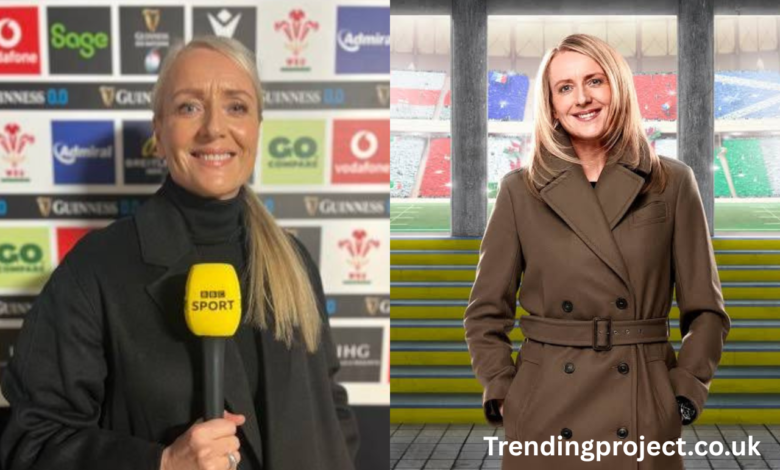
For more than three decades, Sonja McLaughlan has been one of the familiar voices and faces of British sports broadcasting. From the early days of local radio to the biggest rugby grounds in the world, she has built an impressive career by combining strong journalism with an obvious passion for sport. She is especially recognized for her work with BBC Sport, Six Nations rugby, Rugby World Cup coverage and major international sporting events, but the story behind her career is even more interesting than her on-screen appearances. McLaughlan did not begin as a lifelong rugby expert. In fact, when she was first offered the BBC Radio rugby producer role in 1995, she openly admitted that she knew very little about rugby union. What she did possess was journalistic instinct, curiosity, confidence and a determination to learn.
That willingness to learn became one of the defining characteristics of Sonja McLaughlan’s professional life. She entered the BBC in 1988 through a highly competitive trainee scheme, developed her skills in news and local radio, moved into sports production and eventually became one of the most recognizable rugby reporters in British broadcasting. Her career has also taken her well beyond rugby. She has covered athletics, Olympic Games, the London Marathon, The Boat Race and Paralympic sport, demonstrating an ability to move comfortably between different sporting environments.
What makes McLaughlan’s story particularly noteworthy is the period in which she established herself. In the mid-1990s, women were still far less visible in senior rugby broadcasting and production positions. Becoming BBC Radio’s rugby union producer in 1995 therefore represented a significant professional breakthrough. Her career since then has helped demonstrate that expertise in sports journalism is built through preparation, experience and credibility rather than gender or stereotypes.
Sonja McLaughlan Quick Facts
| Category | Details |
|---|---|
| Full name | Sonja McLaughlan |
| Profession | Sports journalist, presenter, reporter and broadcaster |
| Nationality | British |
| Reported date of birth | September 9, 1962* |
| Reported age | 63 in September 2026* |
| Reported birthplace | Molesey, United Kingdom* |
| Known for | BBC Sport, rugby union, Six Nations and athletics coverage |
| BBC career began | 1988 |
| Early BBC role | Trainee reporter and news producer |
| BBC Radio rugby role | Rugby union producer from 1995 |
| Major sports | Rugby, athletics and Olympic sport |
| Olympic career | Coverage beginning with Atlanta 1996 |
| Paralympic work | Channel 4 commentary team, London 2012 |
| Education | Sports degree |
| Parents | Not reliably documented publicly |
| Siblings | Not reliably documented publicly |
| Relationship status | Private/not reliably confirmed |
| Net worth | No independently verified figure |
| X/Twitter | @Sonjamclaughlan |
| Sonja McLaughlan | |
| Public account information is not sufficiently verified |
*The date of birth and birthplace appear in some secondary biographical databases but are not as strongly documented as McLaughlan’s professional career. Her own interviews and established sports-media sources provide considerably more reliable information about her broadcasting history than her private family details.
Early Life, Education and First Steps Toward Journalism
Much of Sonja McLaughlan’s early family life has remained outside the public spotlight. Information about her parents, siblings and childhood household is not comprehensively documented through reliable sources, and McLaughlan herself has generally concentrated public interviews on her professional experiences rather than discussing her family in detail. For that reason, claims about her parents or relatives should be treated cautiously unless they can be traced to a reliable first-hand source.
What is known is that sport became an important part of her life early on. McLaughlan has explained that she studied for a sports degree and that sport was already a major passion. At the same time, she was increasingly attracted to journalism. During university holidays, she worked at the Surrey Comet to experience the reality of a newsroom and determine whether journalism was genuinely the career she wanted. That practical experience was important because it exposed her to the pressures, deadlines and responsibilities of working in the media.
Her route into professional broadcasting was not completely conventional. She initially began teaching, but journalism remained the career she really wanted. While working in her first teaching post, she spotted an advertisement in the Media Guardian for the BBC Local Radio Trainee Reporter Scheme. She applied despite the enormous competition. According to her own recollection, around 5,000 people applied and only 20 were selected. That successful application in 1988 transformed her career path and placed her inside one of Britain’s most respected broadcasting organizations.
Joining the BBC and Developing as a Journalist
McLaughlan’s first years at the BBC were spent developing the fundamentals of journalism. She worked in local radio in Sussex, becoming a news producer at BBC Radio Sussex. This period was crucial because local radio provides journalists with an unusually broad education: reporters must find stories, conduct interviews, understand local issues, work quickly and communicate clearly to audiences.
Her move toward sport came naturally because she had always been interested in athletics and other sports. McLaughlan has recalled playing hockey at a high level during her early career. Working in news also had a practical advantage because it generally allowed her to keep Saturdays free for playing. Eventually, however, she decided that the time had come to make the move into sports broadcasting. A position in network radio sport in London became the next major opportunity.
In 1993, she moved to London and joined the BBC Radio sports department as a producer. This represented a major transition from local journalism into national sports broadcasting. She was now working in an environment where live coverage, major sporting personalities and rapidly changing events required a different kind of preparation. Her journalism background nevertheless proved extremely useful because she already understood how to identify a story, build an interview and communicate information under pressure.
Becoming a BBC Rugby Producer
One of the biggest turning points in Sonja McLaughlan’s career arrived in 1995. Following the Rugby World Cup in South Africa, she was offered the BBC Radio rugby union producer position, taking over from Nick Mullins after he moved into broadcasting. The appointment was significant not only for McLaughlan personally but also for the changing role of women in rugby media.
McLaughlan has recalled that she initially knew remarkably little about rugby union. Rather than hiding that fact, she learned quickly. She even went out and bought a basic rugby book to understand the positions and fundamentals of the sport. Her journalistic background gave her confidence in the areas that mattered most to a producer: understanding news, managing people, preparing interviews and ensuring that the coverage told a coherent story.
The environment she entered was overwhelmingly male. McLaughlan remembered attending her first press conference at Twickenham and being virtually the only woman present who was not working as catering staff. Yet she says she did not experience the dramatic level of direct sexism that might be expected from the era. Instead, she concentrated on doing the work properly. Her philosophy was straightforward: prepare thoroughly, understand the subject and demonstrate that she deserved to be there.
From Rugby Producer to On-Air Broadcaster
McLaughlan eventually expanded beyond production into presenting and reporting. After taking a six-month break, she returned to the BBC in 1998 and worked as a presenter for BBC Radio 5 Live and the BBC News Channel. Her professional identity increasingly became that of a broadcast journalist who could move between reporting, interviewing, presenting and production.
That versatility became particularly valuable in rugby coverage. A touchline reporter has only a few seconds to establish the mood after a match, identify the most important storyline and ask an athlete or coach a question that produces a meaningful answer. McLaughlan’s approach has always emphasized preparation rather than improvisation. She has repeatedly advised aspiring broadcasters not to “wing it” and instead to research their subjects thoroughly before going on air.
Her work has also demonstrated the importance of human-interest journalism in sport. McLaughlan has explained that sometimes the best post-match question is about emotion and pressure, while other situations require a more challenging approach. A reporter needs to understand when to show empathy and when to confront a player or coach with a difficult question. That balance has become one of the recognizable features of her interviewing style.
Sonja McLaughlan and the Six Nations
The Six Nations Championship has been one of the central pillars of McLaughlan’s career. Her first Championship match came in Paris in 1996, and she subsequently spent years covering the competition from both production and television perspectives. In a retrospective interview with the official Six Nations website, she reflected on how extraordinary it was that the tournament had remained part of her professional life for so long.
Her responsibilities have included pitch-side reporting, interviews and presenting. Working at Six Nations matches means dealing with some of the biggest names in international rugby immediately after games, often when emotions are at their highest. A reporter may have only moments to decide whether to ask about a tactical decision, an injury, a controversial incident, a missed opportunity or the wider implications of the result.
McLaughlan has consistently argued that journalists have a responsibility to ask difficult questions when those questions need to be asked. She has used her interview with Stuart Lancaster after England’s heavy defeat by Wales in 2013 as an example. Although it was obvious that Lancaster was deeply disappointed, she believed the reporter still had to ask what audiences wanted to know. That principle has remained central to her approach to rugby journalism.
Rugby World Cup and Major Sporting Events
McLaughlan’s career reached some of its most memorable moments at Rugby World Cups. She has described her work around the 2015 Rugby World Cup as one of the major highlights of her career, particularly because she had an extensive role for BBC Radio 5 Live while also working for host broadcaster ITV. The tournament gave her the opportunity to operate on one of rugby’s biggest international stages.
One particularly memorable assignment came after New Zealand defeated Australia in the 2015 final. McLaughlan was able to interview All Blacks captain Richie McCaw immediately after the match. She knew she had to ask him about his future and whether he would walk away from international rugby after such an extraordinary achievement. For a broadcaster, these are the moments that justify years of preparation and work.
Her Rugby World Cup involvement continued through later tournaments. BBC Sport’s 2019 Rugby World Cup coverage, for example, listed McLaughlan as the lead presenter for its Radio 5 Live team alongside rugby correspondent Chris Jones and former England internationals Matt Dawson and Paul Grayson.
Olympic Games, Athletics and the Paralympics
Although rugby is the sport most closely associated with Sonja McLaughlan, her Olympic broadcasting career reveals another side of her professional ability. She began covering the Olympic Games at Atlanta 1996 and subsequently worked across multiple editions of the Games. Her Olympic experience has included athletics as well as other sporting disciplines.
Her work in athletics has allowed her to report on some of Britain’s most memorable sporting achievements. She has spoken about being present during the rise of Usain Bolt in Beijing in 2008 and witnessing major British performances involving athletes such as Mo Farah, Jessica Ennis-Hill and Greg Rutherford. She also remembers the extraordinary atmosphere at London’s Olympic Stadium in 2012 when Britain won three athletics gold medals within 44 minutes.
McLaughlan has also worked outside traditional BBC rugby coverage. She was part of Channel 4’s commentary team for the London 2012 Paralympic Games and has covered events including the World Athletics Championships, London Marathon and The Boat Race. This variety has allowed her to develop a reputation as a general sports broadcaster rather than someone restricted to one competition.
Breaking Barriers for Women in Sports Broadcasting
McLaughlan’s career is significant in the broader history of women in sports journalism. When she became BBC Radio’s rugby union producer in 1995, women were still relatively uncommon in senior rugby media positions. Her presence in that environment helped challenge the assumption that rugby broadcasting was naturally a male profession.
What makes her story particularly powerful is that she did not build her career around being a novelty. She focused on becoming good at the job. She learned rugby, developed her broadcasting skills and earned credibility with players, coaches, fellow journalists and audiences. Her progression from producer to reporter and presenter shows that her career was built on professional competence rather than symbolic representation alone.
Her work has also extended into women’s rugby, an area that has grown substantially in audience and media attention. McLaughlan has presented and reported on women’s Six Nations fixtures and has highlighted the changing landscape of sports broadcasting. Her experience across several decades gives her a unique perspective on how dramatically opportunities for women in sports media have expanded.
Online Abuse and Professional Resilience
One of the more difficult episodes of McLaughlan’s career came after Wales defeated England 40-24 in the 2021 Six Nations. Following the live broadcast, she interviewed England captain Owen Farrell and head coach Eddie Jones as well as Wales captain Alun Wyn Jones. She subsequently said she had received a large volume of abusive messages online.
The BBC publicly condemned the abuse and strongly supported McLaughlan, describing her as a key member of its Six Nations team. The incident illustrated how social media has changed the pressure faced by sports journalists. A reporter who performs a few minutes of live television can suddenly become the target of thousands of comments from highly emotional supporters.
The episode also highlighted the resilience required in modern broadcasting. McLaughlan continued working despite the experience, demonstrating that criticism and online hostility do not necessarily define the quality or value of a journalist’s work. Her long career has been built on continuing to prepare, report and ask questions regardless of how audiences react.
Personal Life, Family and Interests
Compared with her professional career, Sonja McLaughlan’s private life is relatively low-profile. There is no sufficiently reliable public record establishing detailed information about her parents, siblings or current romantic relationships. She has generally chosen to discuss broadcasting, sport and journalism rather than making her family life a major part of her public identity.
Sport, however, has clearly been an important part of her personal life. Her background in hockey is particularly notable because she was playing regularly while her journalism career was developing. She has explained that she played hockey at a high level before eventually making the move toward sports broadcasting.
Her professional personality also reveals a strong interest in the human side of competition. Whether she is interviewing a rugby captain after a defeat, speaking to an Olympic athlete after a race or presenting a studio programme, her work repeatedly focuses on the stories behind the results. That combination of sporting knowledge and journalistic curiosity has helped keep her relevant throughout a rapidly changing media industry.
Sonja McLaughlan Net Worth and Sources of Income
There is no independently verified public figure that can accurately establish Sonja McLaughlan’s current net worth. Various internet sites publish estimated wealth figures, but these estimates are not supported by publicly available financial records and should not be treated as confirmed. For a professional broadcaster, salary information can also vary considerably depending on employment arrangements, broadcasting contracts, freelance assignments and the number of major sporting events covered.
McLaughlan’s principal professional income has come from her long career in journalism and broadcasting. Her work has included BBC Radio, BBC Sport, television reporting, presenting, commentary and major international sporting assignments. She has also undertaken freelance work and has been represented professionally for presenting and hosting opportunities.
Her career also demonstrates why a broadcaster’s financial picture can be more complicated than a simple salary estimate. Sports media rights frequently change hands, programmes are commissioned and cancelled, and freelance broadcasters can experience periods of uncertainty. McLaughlan has spoken publicly about the challenges of freelance sports broadcasting and the impact that changing rights arrangements can have on broadcasters.
Social Media and Online Presence
McLaughlan maintains a professional presence on social media, particularly through X and LinkedIn. Her online activity tends to focus on broadcasting, sport, professional experiences and major events rather than the kind of lifestyle content commonly associated with entertainment celebrities.
LinkedIn has been especially useful for documenting aspects of her professional career. Posts connected with rugby, Olympic coverage and women’s sport provide audiences with glimpses into the work that takes place behind the scenes. Her online presence therefore complements rather than replaces her traditional broadcasting career.
Her social-media use also reflects the changing nature of journalism. Modern sports broadcasters are no longer limited to television and radio appearances. They can communicate directly with audiences, share professional reflections and participate in conversations surrounding major tournaments. McLaughlan’s career has evolved alongside this transformation.
Recent Career and Continuing Work
McLaughlan’s professional story has not simply become a historical account of BBC rugby coverage. She has continued to appear in sports broadcasting roles and has remained connected with rugby coverage in recent years. Her career has therefore demonstrated unusual longevity in an industry where broadcasting teams, media rights and presentation formats change frequently.
Her experience at the Olympics has also reinforced her willingness to learn new disciplines. She has discussed moving into commentary on sports outside her established areas of expertise and has emphasized the importance of diversification. That mindset is particularly relevant for broadcasters because major sporting rights can move between networks and individual journalists must often adapt to new opportunities.
Her continuing involvement in rugby and international sport also suggests that the next stage of her career can remain varied. Whether through rugby reporting, presenting, commentary, event hosting or mentoring aspiring journalists, McLaughlan has developed a body of experience that extends well beyond any single tournament.
The Legacy of Sonja McLaughlan
Sonja McLaughlan’s career is ultimately a story of persistence and professional evolution. She entered the BBC as a trainee in 1988, developed her skills in local radio, moved into sports production, became BBC Radio’s rugby union producer in 1995 and eventually established herself as a prominent television and radio sports journalist. Along the way, she covered Six Nations rugby, Rugby World Cups, Olympic Games, athletics, the Paralympics and numerous other major sporting events.
Perhaps the most revealing part of her story is that she did not start her rugby career as an expert. She learned. She researched. She asked questions. She accepted that there were things she did not know and then worked hard to understand them. That attitude transformed what could have been an intimidating career challenge into an opportunity to build expertise. Her advice to aspiring broadcasters remains remarkably simple: do the homework, know the subject and never assume that preparation can be replaced by confidence.
As Sonja McLaughlan continues to contribute to sports broadcasting, her story stands as a reminder that lasting careers are rarely created overnight. They are built through preparation, adaptability, resilience and a genuine passion for the work. From a trainee reporter in 1988 to a respected figure on some of the world’s biggest sporting stages, McLaughlan has demonstrated how curiosity can become expertise and how persistence can become a legacy. Her journey is particularly meaningful for the next generation of women entering sports media, but its broader lesson applies to anyone pursuing a demanding profession: opportunities may open the door, but dedication, courage and the willingness to keep learning are what ultimately create a lasting career.