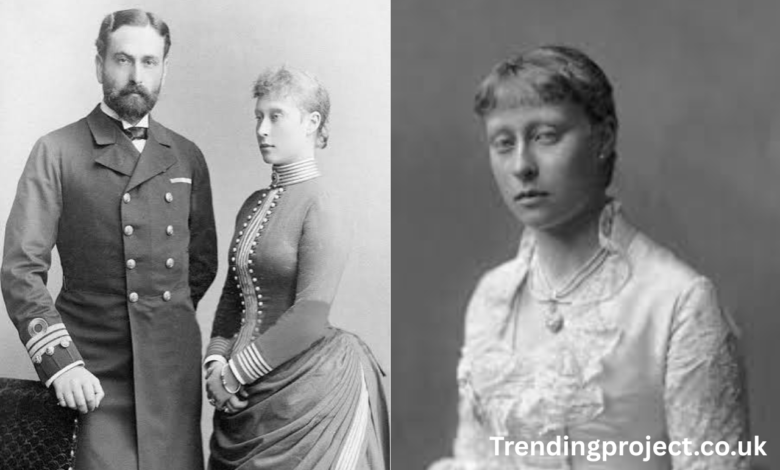
Princess Victoria of Hesse and by Rhine was born into one of the most interconnected royal families in 19th-century Europe, but her story was far more interesting than a simple list of aristocratic titles and family connections. Born at Windsor Castle in 1863, she was the eldest daughter of Louis IV, Grand Duke of Hesse and by Rhine, and Princess Alice of the United Kingdom, making her a granddaughter of Queen Victoria. Over the course of her 87-year life, Victoria witnessed the rise and fall of empires, two world wars, the Russian Revolution, the transformation of the British monarchy, and the disappearance of much of the European aristocratic world into which she had been born.
What made Princess Victoria particularly distinctive was her intellect. She developed a serious interest in geology, archaeology, literature, science, and social philosophy at a time when women of her social position were often expected to concentrate mainly on social duties and marriage. She kept detailed records of the books she read and later became deeply involved in the education of her own children. Her son Louis Mountbatten would remember her as an extraordinarily knowledgeable and methodical woman whose lessons taught him not only facts but also the importance of hard work and thoroughness.
Victoria’s importance also extends into the modern history of the British royal family. She was the mother of Princess Alice of Battenberg, who became the mother of Prince Philip, Duke of Edinburgh, and of Louis Mountbatten, one of the most prominent British naval and political figures of the 20th century. Through these family connections, Victoria became an important link between Queen Victoria’s generation and the royal family of the modern era. Her life was therefore a fascinating combination of intellectual curiosity, family responsibility, personal tragedy, and remarkable historical change.
Quick Facts About Princess Victoria of Hesse and by Rhine
| Category | Details |
|---|---|
| Full name | Victoria Alberta Elisabeth Mathilde Marie |
| Known as | Princess Victoria of Hesse and by Rhine; Victoria Mountbatten |
| Born | April 5, 1863 |
| Birthplace | Windsor Castle, Berkshire, England |
| Died | September 24, 1950 |
| Age at death | 87 |
| Father | Louis IV, Grand Duke of Hesse and by Rhine |
| Mother | Princess Alice of the United Kingdom |
| Maternal grandmother | Queen Victoria |
| Siblings | Elisabeth, Irene, Ernest Louis, Friedrich, Alix and Marie |
| Husband | Prince Louis of Battenberg |
| Marriage date | April 30, 1884 |
| Children | Alice, Louise, George and Louis |
| Later title | Marchioness of Milford Haven |
| Interests | Geology, archaeology, literature, science and social philosophy |
| Notable descendants | Prince Philip and members of the British royal family |
| Net worth | No reliable modern figure exists |
| None; she died in 1950 | |
| Twitter/X | None |
| None |
Early Life and Royal Family Background
Princess Victoria was born on April 5, 1863, at Windsor Castle, an especially significant birthplace because it placed her arrival within the immediate world of her British royal relatives. Her father, Louis IV, was Grand Duke of Hesse and by Rhine, while her mother, Alice, was the second daughter of Queen Victoria and Prince Albert. Victoria consequently belonged to a family that combined British and German dynastic traditions and maintained close relationships with several European royal houses.
Her childhood was divided between England and Germany, and she grew up surrounded by siblings who would later become important historical figures. Her younger sisters included Elisabeth, who became Grand Duchess Elizabeth Feodorovna of Russia, and Alix, who became Empress Alexandra Feodorovna, the wife of Tsar Nicholas II. Her brother Ernest Louis eventually became Grand Duke of Hesse. These family relationships meant that Victoria’s private world was closely connected to the political and dynastic developments taking place throughout Europe.
The influence of her mother was especially important. Princess Alice had a strong sense of duty and placed considerable value on education, practical skills, compassion, and responsibility. Rather than raising her children simply to perform ceremonial roles, she encouraged them to understand the world around them. Victoria absorbed many of these principles, and after her mother’s premature death she would increasingly become a stabilizing and responsible figure within the family.
The Tragedy That Changed Victoria’s Childhood
Victoria’s childhood was permanently altered by a devastating family tragedy in 1878. An outbreak of diphtheria struck the Hesse household, affecting several members of the family. Princess Alice herself became ill and died on December 14, 1878, at only 35 years of age. Victoria was still a teenager, and the sudden loss of her mother created a profound emotional and practical change within the family.
As the eldest daughter, Victoria naturally became more important to her younger siblings. She was not their mother, but she could provide maturity, organization, and emotional stability at a time when the family had experienced an extraordinary loss. This responsibility likely strengthened qualities that would become characteristic of her adult personality: independence, practicality, self-discipline, and an ability to cope with difficult circumstances.
The tragedy also reinforced Victoria’s appreciation for knowledge and education. She became increasingly intellectually independent and developed interests that went well beyond conventional royal accomplishments. Her later reading records demonstrate how broadly she educated herself, while her interest in science and archaeology shows that her curiosity was not limited to literature or history.
Princess Victoria’s Education and Intellectual Interests
One of the most fascinating aspects of Princess Victoria’s biography is her lifelong relationship with learning. She maintained leather-bound volumes containing lists of books she had read, creating an unusually detailed record of her intellectual development. The subjects she explored included geology, archaeology, social philosophy, and a wide range of literature. Her reading habits suggest that she was not interested merely in collecting accomplishments but genuinely enjoyed acquiring knowledge.
Her interest in science was particularly unusual for a woman of her social background during the Victorian period. While royal women could certainly be educated and intellectually accomplished, scientific investigation was not normally at the center of aristocratic feminine life. Victoria’s fascination with geology led her to create a detailed geological map of Malta, and she also participated in archaeological excavations in Malta and Germany.
Victoria’s intellectual curiosity also shaped the way she interacted with people. She was known for being outspoken and open-minded, qualities that her son Louis Mountbatten later emphasized when describing her personality. Rather than treating education as something formal and restrictive, she believed knowledge should be useful, interesting, and connected to the wider world. This attitude became one of the most enduring features of her character.
Marriage to Prince Louis of Battenberg
Princess Victoria married Prince Louis of Battenberg on April 30, 1884, in Darmstadt. Louis came from the Battenberg family and pursued a career in the British Royal Navy, creating a strong connection between Victoria’s continental European royal background and Britain’s naval establishment. Their marriage gave Victoria a new position in British aristocratic society while maintaining her close links with her German relatives.
The couple established their married life in Britain and eventually had four children. Their first child, Alice, was born in 1885, followed by Louise in 1889, George in 1892, and Louis in 1900. Their children would go on to create an extraordinary family network that connected Britain, Greece, Sweden, and other European royal houses.
Victoria’s marriage also brought her into closer contact with naval life. When Louis was serving with the Mediterranean Fleet, she spent several winters in Malta. During one visit she became seriously ill with typhoid in 1887, but recovered sufficiently to attend Queen Victoria’s Golden Jubilee celebrations in London later that year. Her time in Malta also gave her opportunities to pursue her scientific and archaeological interests.
A Mother Who Personally Educated Her Children
Victoria’s influence became especially powerful through her role as a mother. Rather than leaving her children’s intellectual development entirely to professional tutors, she took an active role in their education. Her approach was structured and demanding, with lessons organized carefully and preparation expected before each subject. Her son Louis Mountbatten later recalled the disciplined educational system his mother created for him.
Louis described his mother as a “walking encyclopedia,” emphasizing her enormous store of knowledge and her ability to make learning interesting. He remembered that she created timetables for subjects, required preparation, and taught him to enjoy working hard and to be thorough. Such memories provide an unusually personal insight into Victoria’s parenting style and help explain why education was such an important part of her legacy.
Her children were raised during a period when European royal families were becoming increasingly connected through marriage but also increasingly vulnerable to political change. Victoria therefore had to prepare them for a world that could not be predicted simply from their titles. Her emphasis on knowledge, discipline, and independence proved valuable as her children encountered military careers, royal marriages, international politics, and personal tragedy.
Her Children and Their Extraordinary Descendants
Victoria’s eldest child, Princess Alice of Battenberg, married Prince Andrew of Greece and Denmark. Their son, Prince Philip, was born in 1921 and would later marry Princess Elizabeth, the future Queen Elizabeth II. This made Victoria the maternal grandmother of the man who would become the longest-serving consort in British royal history.
Her daughter Louise eventually became Queen of Sweden after marrying Crown Prince Gustaf Adolf, while her son George became the second Marquess of Milford Haven. Her youngest son, Louis Mountbatten, became one of the best-known members of the family. He served in the Royal Navy, rose to senior command, and later became the last Viceroy of India before Indian independence.
The achievements and experiences of Victoria’s children demonstrate the extraordinary reach of her family. One daughter became a queen, another became the mother of a future British royal consort, and her youngest son became an influential military and political figure. Victoria herself did not occupy a throne, but her descendants placed her firmly within the history of several European monarchies.
Victoria and the Mountbatten Name
The First World War transformed the meaning of German ancestry among Britain’s royal and aristocratic families. Anti-German feeling became intense, and members of the British establishment with German titles faced increasing pressure to demonstrate their British identity. Victoria’s husband, Louis, was deeply affected by these circumstances because of his Battenberg background and his position in the Royal Navy.
In 1917, the family abandoned the German Battenberg name and adopted the English form Mountbatten. The change reflected the enormous political and social impact of the war. It was more than a simple alteration of spelling: it demonstrated how European royal identities could be reshaped by nationalism and public opinion.
Victoria therefore lived through one of the most important transformations in the history of European royalty. She had been born into a German grand-ducal family closely connected with Britain, married into the Battenberg family, and later became associated with the Mountbatten name. Her life illustrates how political events could alter even the identities of people born into the highest levels of society.
Family Connections to the Russian Imperial Family
Victoria’s family relationships became particularly tragic during the Russian Revolution. Her sisters Elisabeth and Alix both married into the Russian imperial family. Elisabeth became Grand Duchess Elizabeth Feodorovna, while Alix became Empress Alexandra Feodorovna, the wife of Nicholas II. These marriages placed Victoria’s sisters at the heart of the Russian imperial court.
The revolution transformed their lives catastrophically. Tsar Nicholas II, Alexandra, their children, and members of their household were murdered in 1918. Victoria’s sister Elisabeth was also killed during the revolutionary violence. The events represented not only personal tragedies for Victoria but also the destruction of one of Europe’s oldest imperial dynasties.
For Victoria, these events reinforced a reality she had already begun to understand: royal privilege did not provide immunity from political upheaval. The world of dynastic certainty in which she had been raised was disappearing rapidly. Several of her relatives lost their titles, homes, wealth, or lives as monarchies collapsed across Europe.
Princess Victoria During the First and Second World Wars
The two world wars created extraordinary pressures for Victoria and her extended family. During the First World War, her family connections to Germany became politically sensitive, while her husband’s career placed him firmly within the British establishment. The conflict demonstrated how difficult it could be for European royal families to maintain traditional cross-border relationships when their countries were at war.
The Second World War brought another period of danger and uncertainty. Victoria’s family members served in different capacities, while Europe was once again divided by military conflict. Her son Louis Mountbatten became an important naval commander, and her grandson Prince Philip also served in the Royal Navy. Victoria’s family was therefore deeply involved in Britain’s wartime generation.
In October 1940, Victoria’s apartment at Kensington Palace was damaged by bombing, and she subsequently spent time at Windsor Castle. The experience showed that even senior members of the royal family were not completely removed from the dangers facing ordinary British citizens during the Blitz. Her long life had now witnessed two devastating world wars and the destruction of the political order of her childhood.
Princess Victoria and Prince Philip
One of Victoria’s most significant relationships was with her grandson Prince Philip. Philip’s childhood was unusually unsettled. His family was forced into exile from Greece, his parents separated, and he spent substantial periods being cared for by relatives and schools. Victoria provided an important connection to the wider family network during these difficult years.
Her influence on Philip was not simply genealogical. She represented stability, knowledge, and discipline at a time when his childhood was characterized by upheaval. Her intellectual approach to education and her practical personality were qualities that remained associated with the family environment around him.
Philip’s later marriage to Princess Elizabeth brought Victoria’s family connection directly into the British monarchy. When Elizabeth became Queen Elizabeth II in 1952, Victoria had already died, but the family legacy she helped shape had entered a new historical era. Her influence consequently reached far beyond her own lifetime.
Personality, Character and Personal Interests
Princess Victoria was remembered as intelligent, outspoken, methodical, and remarkably curious. She did not fit comfortably into the stereotype of a passive Victorian princess. Her enthusiasm for geology and archaeology, extensive reading, and interest in social philosophy demonstrate an active intellectual life. She was fascinated by ideas and apparently enjoyed discussing subjects that went well beyond royal protocol.
Her personality also had a practical side. She valued organization and expected people to prepare properly for their responsibilities. This was particularly evident in the way she educated her children. Her son Louis Mountbatten’s recollections portray her as someone who combined enormous knowledge with an ability to communicate it effectively.
Perhaps most striking was her open-mindedness. Mountbatten later described his mother as unusually outspoken and free from prejudice for someone from her background. While historical assessments must always be placed within the context of the Victorian and Edwardian periods, this description helps explain why Victoria stood out within her family. She possessed both the advantages of an aristocratic education and a genuine appetite for ideas.
Princess Victoria of Hesse and by Rhine’s Net Worth
It is tempting for modern biography websites to assign a precise dollar figure to the wealth of historical royals, but doing so with Princess Victoria would be misleading. There is no reliable modern calculation that can accurately establish her personal net worth. Her financial circumstances were tied to aristocratic income, family wealth, inheritance, marriage, and the changing economic structures of European royalty.
Victoria did receive financial resources associated with her family position, and after Queen Victoria’s death her grandmother’s will provided her with an increase in annual income. However, translating such historical financial arrangements into a modern “net worth” number would require assumptions that cannot be supported with confidence. A responsible biography should therefore distinguish documented income or property from speculative estimates.
The most accurate answer is that Princess Victoria of Hesse and by Rhine’s net worth is unknown. Her historical significance does not depend on a modern wealth ranking. Her real legacy lies in her intellectual interests, her children and grandchildren, and her place within the extraordinary network of European royal families.
Social Media and Public Presence
Princess Victoria obviously did not have Instagram, Twitter/X, Facebook, LinkedIn, or any other social-media profile. She died in 1950, decades before the emergence of the internet and modern digital communication. Any account claiming to be an authentic personal social-media profile belonging to her should therefore be regarded as fictional, commemorative, or unofficial.
Her modern presence instead exists through historical photographs, royal archives, genealogical research, biographies, museum collections, and digital history websites. Interest in her has remained strong partly because of her connection to Queen Victoria and partly because her descendants include figures who played major roles in modern British and European history.
Victoria’s story is especially relevant to people researching the Hesse and by Rhine family, Queen Victoria’s descendants, the Battenberg family, the Mountbatten dynasty, Prince Philip’s ancestry, and the wider history of European royalty. Her biography provides a fascinating bridge between Victorian Britain and the royal world of the 20th century.
Later Years and Death
Victoria’s later life was shaped by the accumulated experiences of almost nine decades. She had watched the Victorian world disappear, seen relatives lose thrones and lives, experienced two world wars, and watched her children take on increasingly important roles. Yet she remained connected to the family network that had been central to her identity since childhood.
She also lived long enough to see her grandson Philip marry Princess Elizabeth in 1947. This was an extraordinary moment in family history because Victoria’s grandson was marrying into the British royal family descended from her own grandmother, Queen Victoria. The event effectively connected several generations of the family in a way that would shape the monarchy for decades.
Victoria died at Kensington Palace on September 24, 1950, at the age of 87. She was buried on September 28 at St Mildred’s Church, Whippingham, on the Isle of Wight. Her death marked the end of the life of a woman who had experienced an extraordinary span of European history.
The Lasting Legacy of Princess Victoria
Princess Victoria of Hesse and by Rhine is sometimes overshadowed by the more famous people in her family. Queen Victoria, Empress Alexandra, Tsar Nicholas II, Prince Philip, Queen Elizabeth II, and Louis Mountbatten have all attracted enormous public attention. Yet Victoria herself provides an important perspective on the family because she was a central figure connecting several generations.
Her legacy can be seen most clearly through education. She took knowledge seriously, maintained extensive reading records, explored scientific and archaeological subjects, and passed her intellectual discipline to her children. Her influence was especially significant for Louis Mountbatten, who remembered her as a remarkable teacher and credited her with teaching him to work hard and be thorough.
Her life also offers a lesson about resilience. Born into extraordinary privilege, she nevertheless experienced the death of her mother, the loss of siblings and relatives through revolution and war, the transformation of royal identities, and the deaths of members of her own immediate family. Through all of this, she remained an important source of stability for the people around her.
Conclusion: Why Princess Victoria Still Matters
Princess Victoria of Hesse and by Rhine was born into the Victorian royal world but lived long enough to witness its transformation into something almost unrecognizable. She was the granddaughter of Queen Victoria, the daughter of Princess Alice, the wife of Prince Louis of Battenberg, the mother of Louis Mountbatten and Princess Alice, and the grandmother of Prince Philip. Yet her importance cannot be reduced to genealogy.
Her intellectual curiosity made her unusual. Her devotion to education gave her influence within her family. Her practical personality helped her navigate periods of extraordinary upheaval, while her experiences connected her personally to some of the most dramatic events in modern European history. From geological exploration and archaeological interests to royal family education and wartime survival, her life contained far more substance than the conventional image of a Victorian princess suggests.
Ultimately, Princess Victoria’s story is a reminder that historical influence does not always come from sitting on a throne. Sometimes it comes from educating the next generation, encouraging curiosity, providing stability during difficult times, and passing knowledge and values from one generation to another. Her descendants helped shape the British monarchy and modern European history, ensuring that the quiet influence of Princess Victoria of Hesse and by Rhine continued long after her death in 1950.