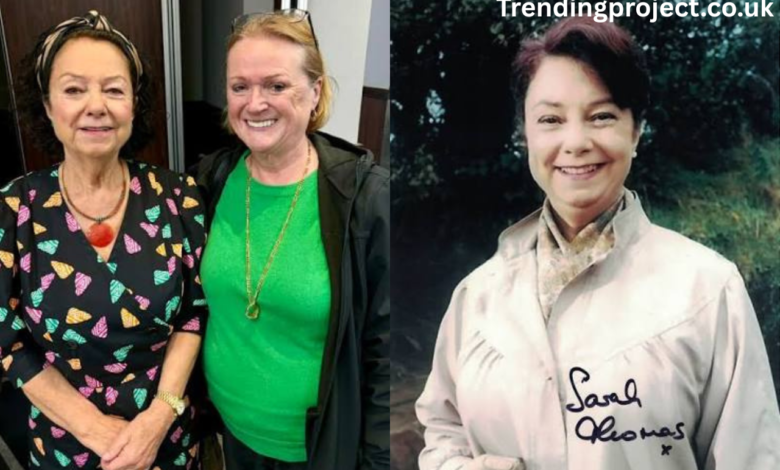
British television has produced countless actors who became familiar faces without ever chasing the intense publicity surrounding modern celebrity culture. Sarah Thomas is one of them. For generations of viewers, her face was closely associated with warm, character-driven British comedy, particularly through her unforgettable portrayal of Glenda Wilkinson in Last of the Summer Wine. Yet behind that famous role was an experienced actress whose career reached into drama, children’s television, film, theatre and pantomime.
Born Sarah Jane Thomas on June 5, 1952, in London, England, she entered professional acting during the early 1970s and gradually established herself through a series of television appearances. Her career included Special Branch, Within These Walls, The Velvet Glove, Worzel Gummidge, Blackadder, Heartbeat, The Bill and Doctors, alongside film and extensive stage work.
But it was her 25-year association with Last of the Summer Wine that transformed Sarah Thomas from a working British actress into a performer remembered by millions. As Glenda, she became part of one of television’s most enduring ensembles, demonstrating that a successful acting career is not always built around blockbuster movies or celebrity headlines. Sometimes it is built around a character that audiences simply never forget.
Sarah Thomas Biography and Quick Facts
Sarah Thomas was born in London in 1952 and is an English actress whose professional career spans several decades. Her best-known television roles include Glenda Wilkinson in Last of the Summer Wine and Enid Simmons in Worzel Gummidge.
Her career also reflects the traditional British acting path in which television performers frequently move between sitcoms, serious dramas, theatre productions and pantomime. Thomas did exactly that, building an impressive résumé without becoming overly dependent on one medium or genre.
One important point when researching Sarah Thomas is that some online biographies contain conflicting or inaccurate information about her later life. A more dependable picture comes from established career databases and her own 2020 theatre interview, which documents her professional work as Miss Marple.
| Category | Information |
|---|---|
| Full name | Sarah Jane Thomas |
| Date of birth | June 5, 1952 |
| Age | 74 in 2026 |
| Birthplace | London, England |
| Nationality | English/British |
| Profession | Actress |
| Best known role | Glenda Wilkinson in Last of the Summer Wine |
| Other notable role | Enid Simmons in Worzel Gummidge |
| Television career began | Special Branch, 1970 |
| Years as Glenda | 1986–2010 |
| Last of the Summer Wine episodes | 215 credited episodes |
| Theatre roles | Miss Marple, Mrs. Danvers and others |
| Film credit | Madagascar Skin |
| Parents | Not reliably documented in major public sources |
| Siblings | Not reliably documented |
| Education | Drama-school training is mentioned by Thomas, but institution is not clearly established in the sources reviewed |
| Net worth | No verified public figure |
| No verified official account identified | |
| X/Twitter | No verified official account identified |
| No verified official account identified |
Early Life and Family Background
Sarah Thomas was born in London on June 5, 1952, at a time when British television and theatre were entering an exciting period of growth. The post-war entertainment landscape was changing quickly, with television becoming an increasingly important part of everyday life. For a future actress, growing up in London also meant being surrounded by an enormous theatrical and cultural environment.
Thomas has offered one particularly valuable glimpse into her childhood motivation. In a 2020 interview with The Courtyard, she explained that her mother introduced her to the arts by taking her to plays and ballet when she was young, helping establish her love of theatre. She described that early influence as the beginning of her interest in acting.
Detailed information about Thomas’s parents, siblings and wider family remains limited in reputable public sources. Rather than repeating unverified claims found on biography websites, it is more responsible to acknowledge that these aspects of her private life have largely remained outside the public record. What is clear is that her mother’s encouragement played an important role in introducing her to performance and the theatre.
Education and Decision to Become an Actress
Sarah Thomas has stated that she went to drama school before working with various theatre companies. This provides an important insight into the foundation of her career because her route into acting appears to have combined formal theatrical training with practical experience on stage.
Drama school can be demanding because performers are expected to develop much more than the ability to memorize lines. Training generally involves voice, movement, character development, improvisation, stagecraft and an understanding of how actors interact within an ensemble. Thomas’s later career suggests that this broad foundation served her well.
Her own description of her ideal career is revealing. In the 2020 interview, Thomas said that a mixture of theatre and television was perfect for her. That philosophy neatly describes the career she eventually created, because she never confined herself to one form of acting. Television gave her widespread recognition, while theatre provided opportunities to tackle very different characters.
Sarah Thomas’s First Television Roles
Sarah Thomas began her television career with an appearance in the British drama Special Branch in 1970. IMDb identifies the programme among the earliest notable credits associated with her career, marking the beginning of a professional screen journey that would eventually span decades.
During the years that followed, she accumulated roles in productions such as Within These Walls, The Velvet Glove and Together. These early appearances may not have made her an overnight household name, but they gave her the opportunity to gain valuable experience working in different television environments and alongside established performers.
For many British actors of her generation, this kind of gradual career development was normal. Performers frequently moved from one guest role to another while building relationships, experience and recognition. Thomas followed that path patiently, eventually arriving at roles that would give her a much larger and more enduring audience.
Sarah Thomas in Worzel Gummidge
Before Last of the Summer Wine, one of Sarah Thomas’s important television roles came in the much-loved children’s series Worzel Gummidge. She played Enid Simmons, appearing in several episodes between 1979 and 1981.
The programme was based on the characters created by Barbara Euphan Todd and became an important part of British family television. Thomas’s work on the series introduced her to younger viewers while also allowing her to work within a distinctly British blend of fantasy, comedy and family entertainment.
Her Worzel Gummidge connection remained part of her professional identity even years later. Her 2020 theatre profile specifically described her as being known for both Worzel Gummidge and her 25-year run in Last of the Summer Wine.
Sarah Thomas as Glenda Wilkinson in Last of the Summer Wine
The defining role of Sarah Thomas’s career was undoubtedly Glenda Wilkinson in Last of the Summer Wine. She joined the long-running BBC sitcom during the 1980s and remained connected with the programme until its final episode in 2010.
Glenda was part of the Wilkinson family and became closely connected with Barry, played by Mike Grady. Her character occupied an important place within the show’s extensive ensemble, contributing to storylines that revolved around marriage, friendship, neighborhood relationships and the wonderfully eccentric situations for which the sitcom became famous.
According to British Comedy Guide’s episode listings, Thomas’s Glenda appeared across numerous series and specials, while IMDb credits her with 215 episodes. That extraordinary number helps explain why the role became so closely associated with her identity as an actress.
Why Glenda Wilkinson Became So Memorable
Glenda was not simply another supporting character inserted into the sitcom’s crowded world. Her relationships with other characters gave her a distinct personality, and Sarah Thomas brought a natural, understated quality to the role that fitted the show’s style.
One of the reasons the character worked so well was the contrast between Glenda and the eccentric people surrounding her. She could appear sensible and grounded in one moment and become involved in the show’s increasingly ridiculous situations the next. That contrast created much of the gentle comedy associated with the character.
Thomas’s performance also benefited from the show’s long-running ensemble structure. Last of the Summer Wine was rarely about one individual actor dominating every scene. Instead, its humor came from combinations of characters, recurring relationships and familiar personalities. Thomas understood that style and became an important piece of the larger ensemble.
A Quarter Century on British Television
Remaining on one television programme for approximately 25 years is an extraordinary achievement. During Thomas’s time on Last of the Summer Wine, the television industry itself changed dramatically, yet the sitcom continued to attract audiences.
Thomas joined a production whose appeal depended heavily on familiarity. Viewers became attached not only to the central characters but also to the wider community surrounding them. Glenda therefore benefited from the unusual longevity of the series, allowing audiences to watch the character’s relationships develop over many years.
The experience also gave Thomas a rare opportunity to create a television character with genuine continuity. Instead of appearing for one season and disappearing, she returned repeatedly and became part of the show’s long-term history. British Comedy Guide’s archive demonstrates just how extensively Glenda appeared across later seasons.
Other Television Appearances
Although Glenda Wilkinson became her signature character, Sarah Thomas continued to work outside Last of the Summer Wine. Her television credits include The Black Adder, where she appeared as Mrs. Field, a Goodwife, in the episode “Witchsmeller Pursuivant.”
She also appeared in productions including Miracles Take Longer, Shroud for a Nightingale and Happy Families. These roles demonstrate that her professional interests extended beyond sitcoms and that she was comfortable working in different television genres.
Later credits included Heartbeat, The Bill and Doctors. IMDb identifies her as appearing in Madagascar Skin as well, showing that her career included feature-film work alongside television and theatre.
Sarah Thomas’s Film Career
Thomas’s film résumé is smaller than her television résumé, but that does not diminish its significance. Her best-known film credit is Madagascar Skin, a 1995 British film in which she was credited as the Crab Hunter.
For a performer whose reputation was primarily established through British television and theatre, film was one element of a much wider acting portfolio. Her career demonstrates that she did not necessarily measure success by the number of feature films she made.
Instead, television remained her strongest professional platform. That medium offered the continuity that allowed her to develop recurring characters while theatre gave her opportunities to explore completely different forms of performance.
Sarah Thomas’s Theatre Career
Theatre has always been a significant part of Sarah Thomas’s professional life. In her own words, she went to drama school and subsequently worked with a number of theatre companies, eventually finding a balance between stage and television work.
Among her notable theatre roles was Mrs. Danvers in Rebecca, a very different character from the warm and comic Glenda Wilkinson. Such a role requires a darker and more psychologically controlled style of performance, demonstrating the range that can sometimes be hidden behind a famous sitcom role.
Her stage career is particularly important when evaluating Sarah Thomas as an actress. Television viewers may primarily remember her as Glenda, but theatre allowed her to step away from that familiar identity and demonstrate that she could tackle dramatic, mysterious and demanding characters.
Sarah Thomas as Miss Marple
One of the most fascinating later chapters of Thomas’s career involved Agatha Christie’s A Murder Is Announced. She toured with Middle Ground Theatre Company’s production and eventually took on the role of Miss Marple.
In her 2020 interview with The Courtyard, Thomas described Miss Marple as a great deal of fun to play. She acknowledged that several actresses had already created their own versions of the character and explained that the challenge was therefore to develop her own interpretation.
Her understanding of Marple also reveals something about her approach to acting. She emphasized the character’s seemingly harmless exterior while focusing on her intelligence and ability to notice clues that others miss. Thomas had originally played Bunny in the production, but by the later tours she had taken over the central detective role.
Sarah Thomas and Pantomime
Pantomime became another recurring element of Sarah Thomas’s career. Her appearances included productions such as Robin Hood and the Babes in the Wood, Snow White and the Seven Dwarfs, Cinderella, Aladdin and Jack and the Beanstalk.
In 2007–08, she appeared as the Fairy Godmother in Cinderella at the Assembly Hall Theatre in Tunbridge Wells. She returned to the role during the 2008–09 season at the Grand Theatre in Swansea, showing her continued connection with live family entertainment.
She subsequently appeared in Jack and the Beanstalk at Malvern Theatre during the 2009–10 season. These productions demonstrate another side of her career: the ability to perform live, respond to audiences and embrace the energetic traditions of British pantomime.
Sarah Thomas’s Personality and Acting Philosophy
The available interviews suggest that Thomas has always viewed acting as a craft rather than simply a route to celebrity. Her comments about theatre, television and Miss Marple reveal an actress interested in character, interpretation and the relationship between performer and audience.
Her love of theatre can be traced back to childhood, when her mother took her to plays and ballet. That early exposure appears to have created a lasting appreciation for live performance and ultimately influenced her decision to pursue formal drama training.
Perhaps the most revealing part of her career philosophy is her appreciation for variety. Thomas specifically described a combination of theatre and television as ideal. Her résumé reflects exactly that balance, moving from sitcoms to drama, children’s television, film, pantomime and classic mystery theatre.
Sarah Thomas’s Personal Life
Sarah Thomas has generally kept her personal life away from the intense publicity that surrounds many modern entertainers. As a result, reliable information about her romantic relationships, marriage, children and everyday family life is limited.
That privacy should be respected rather than replaced with speculation. Many online biography pages publish personal details without providing strong sources, but a careful examination of established career records and interviews does not provide enough evidence to construct a detailed account of her private relationships.
What can be discussed confidently is the influence of her mother on her artistic development. Thomas herself has explained that her mother introduced her to plays and ballet, making family encouragement an important part of her early connection with the performing arts.
Sarah Thomas Age and Later Career
Born June 5, 1952, Sarah Thomas is 74 years old in 2026. Both IMDb and British Comedy Guide list her birth date, while British Comedy Guide currently identifies her as 74.
Her career did not simply stop when Last of the Summer Wine ended. Her documented work included a 2011 appearance in Doctors, while her theatre career continued into later years, including the Miss Marple production discussed in 2020.
This distinction matters because the conclusion of Last of the Summer Wine represented the end of a television institution, not necessarily the end of Sarah Thomas’s professional identity. Her later theatre work demonstrates that she continued to engage with acting beyond the role that made her famous.
Sarah Thomas Net Worth and Sources of Income
There is no reliable, independently verified figure for Sarah Thomas’s net worth. Celebrity wealth websites sometimes publish exact amounts, but without documented salaries, investments, property holdings or financial statements, such numbers should not be presented as fact.
Her income over the decades would have come primarily from acting. That includes television performances, theatre productions, pantomime, film work and potentially related residual or contractual payments, although the precise financial arrangements for individual productions are not publicly documented.
Her long tenure on Last of the Summer Wine would logically represent an important part of her professional earnings, but it would be inappropriate to turn that assumption into a specific salary or net-worth estimate. A responsible biography should simply state that her financial position remains private.
Sarah Thomas on Social Media
Unlike many contemporary celebrities, Sarah Thomas does not appear to have a clearly verified and widely documented official Instagram, X/Twitter or LinkedIn presence. This means readers should be cautious when encountering social-media profiles claiming to represent her.
The absence of a strong public social-media presence is not surprising given that most of Thomas’s career was established before Instagram, Facebook and modern creator culture became central to celebrity life. Her audience connection was built through television screens, theatre audiences and traditional media.
In many ways, her career represents a different model of fame. Sarah Thomas became recognizable because viewers repeatedly encountered her work, not because she constantly shared personal photographs, opinions or behind-the-scenes updates online.
What Sarah Thomas’s Career Teaches Us
The most obvious lesson from Sarah Thomas’s career is the value of longevity. She did not need one blockbuster movie to establish herself. Instead, she worked consistently across decades, gradually accumulating roles and becoming an important part of British television culture.
Her career also demonstrates why versatility matters. Thomas moved between sitcoms, drama, children’s television, film, theatre and pantomime. Her portrayal of Glenda Wilkinson might be her most recognizable performance, but her later work as Miss Marple shows that she remained willing to take on new challenges.
Most importantly, her story illustrates that an actor’s legacy can be built through consistency. A performer does not necessarily need to dominate headlines to make a meaningful contribution to entertainment. Sometimes the greatest achievement is becoming part of people’s lives through characters they welcome back year after year.
Sarah Thomas’s Lasting Legacy
Sarah Thomas occupies a special place in the history of British television because her career connects several generations of entertainment. From early television drama in the 1970s to Worzel Gummidge, Blackadder, Last of the Summer Wine and later theatre productions, her working life reflects the breadth of Britain’s acting tradition.
Glenda Wilkinson remains her defining television role, and the scale of Thomas’s contribution to Last of the Summer Wine is remarkable. Spending roughly a quarter of a century within the same beloved sitcom gave her an opportunity that few actors receive: to become part of a fictional world that audiences returned to across decades.
Yet her legacy should not be limited to one character. Sarah Thomas was a trained actress who embraced television and theatre, performed comedy and drama, appeared in children’s entertainment and took on iconic literary characters. Her career is therefore best understood as a long and varied body of work rather than simply the story of one sitcom performer.
Conclusion
Sarah Thomas’s acting journey is a quietly impressive example of what can happen when talent is combined with patience, versatility and a genuine love of performance. From the early influence of her mother taking her to plays and ballet, through drama school and early television appearances, she steadily built a professional life that would eventually span more than four decades.
Her portrayal of Glenda Wilkinson in Last of the Summer Wine gave her a permanent place in British television history, but her career reached much further. Worzel Gummidge, Blackadder, Heartbeat, The Bill, Doctors, film work, pantomime and theatre all contributed to a résumé that demonstrates remarkable range. Her later portrayal of Miss Marple was particularly fitting because it allowed audiences to see another dimension of an actress already known for her comic timing.
Ultimately, Sarah Thomas’s story is not one of instant fame. It is a story of steady growth, professional resilience and lasting craft. Her career reminds us that meaningful success can be created quietly, one role at a time, and that an actor’s greatest legacy may be the characters that continue living in audiences’ memories long after the cameras stop rolling. As Sarah Thomas’s work continues to be rediscovered by viewers old and new, her journey remains a powerful reminder that perseverance, adaptability and passion can build a legacy that lasts far beyond any single performance.