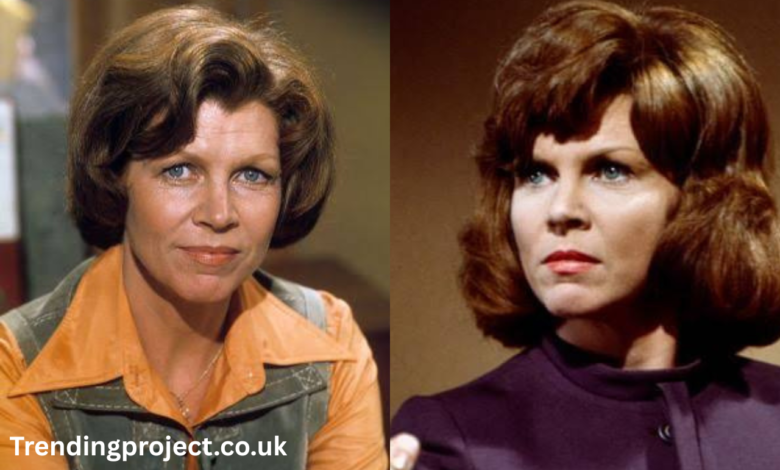
Sarah Lawson built the kind of acting career that becomes more interesting with time. Born in London in 1928, she entered professional acting in the years following the Second World War and went on to work across British theatre, cinema and television for more than four decades. While she never became a conventional Hollywood-style superstar, she developed something arguably more enduring: a reputation as a versatile and dependable British character actress whose performances could fit naturally into dramas, thrillers, science fiction, horror and crime television. Her career included appearances in productions such as The Browning Version, The Trollenberg Terror, Night of the Big Heat, The Devil Rides Out, Battle of Britain, The Avengers, The Saint, Department S, Callan, The Persuaders!, Within These Walls and Bergerac.
What makes Sarah Lawson’s story particularly compelling is the breadth of the journey behind those credits. She did not simply arrive on television as an established star. She trained at the Webber Douglas Academy of Dramatic Art, worked in repertory theatre, reached London’s West End and gradually established herself on screen. Her career was built through years of professional experience rather than a single breakthrough. By the time she became especially recognizable to fans of British horror and classic television, she had already accumulated a substantial body of theatrical and screen work.
Lawson also lived through an extraordinary period in British entertainment history. She began acting when television was still developing into a mass medium, worked during the flourishing years of British cinema and Hammer horror, and later became a familiar face in the crime and adventure series that dominated British television. Her story is therefore not only the biography of one actress but also a window into the changing world of twentieth-century British performance. She died in London on August 18, 2023, aged 95, but her performances continue to introduce her to new audiences.
Sarah Lawson Facts at a Glance
| Fact | Details |
|---|---|
| Full name | Sarah Elizabeth Lawson |
| Born | August 6, 1928 |
| Birthplace | London, England |
| Died | August 18, 2023 |
| Age at death | 95 |
| Profession | Actress |
| Nationality | British |
| Education | Webber Douglas Academy of Dramatic Art |
| Father | Noel Lawson, a naval officer/master mariner |
| Mother | Edith Lawson, née Monteith |
| Siblings | Youngest of three children; one brother and one sister |
| Husband | Patrick Allen |
| Marriage | 1960 until Allen’s death in 2006 |
| Children | Two sons, Stephen and Stuart |
| Major films | The Devil Rides Out, Night of the Big Heat, Battle of Britain |
| Major TV work | Callan, Within These Walls, The Avengers, The Saint, Bergerac |
| Acting career | Approximately 1948–1989 |
| Net worth | No reliable public figure available |
| No verified official account found | |
| X/Twitter | No verified official account found |
| No verified official account found | |
| Cause of death | Cancer |
The available biographical sources consistently identify Lawson as Sarah Elizabeth Lawson, born August 6, 1928, and confirm that she died at 95 in 2023. Her professional training, family background, marriage to Patrick Allen and extensive screen career are documented in biographical and film references.
Who Was Sarah Lawson?
Sarah Lawson was an English actress who worked primarily in British theatre, film and television. Her career is a strong example of the traditional British acting pathway, in which formal dramatic training was followed by repertory theatre, West End appearances and increasingly frequent work in television and film. She developed the flexibility required to move between very different productions, something particularly evident in the contrast between her theatrical work, Hammer horror appearances and later television crime dramas.
Although she appeared in some prominent films, Lawson’s greatest professional footprint was arguably on television. She became a familiar face in a wide range of British series, including The Avengers, The Saint, Department S, Callan, The Persuaders!, Father Brown and Bergerac. Rather than being tied permanently to one type of character, she repeatedly adapted to the requirements of individual productions.
This versatility explains why her career remains interesting to classic television enthusiasts. A viewer might encounter Lawson in a serious drama and later discover her in a supernatural thriller or crime series without immediately realizing that the same actress was involved. Her ability to inhabit different dramatic environments became one of the defining qualities of her professional life.
Early Life and Family Background
Sarah Elizabeth Lawson was born in London on August 6, 1928. She was the youngest of three children born to Noel Lawson and Edith Lawson, née Monteith. Her father was associated with the naval world, while her family also had an artistic connection through her grandfather Francis Wilfred Lawson, a Victorian painter and illustrator. These details provide an interesting backdrop to Lawson’s later decision to pursue a creative profession.
Lawson grew up in West Sussex rather than spending her entire childhood in London. During her school years at Herons Ghyll Roman Catholic School, she became involved in amateur theatrical productions. Those early performances gave her the opportunity to experience acting before she entered professional training, and they appear to have reinforced a desire that she had held from a young age: to become an actress.
Her family life was not untouched by the upheavals of the Second World War. Biographical records note that Lawson had a brother who was killed in action while serving on a submarine. Such experiences formed part of the difficult historical environment surrounding her youth and early adulthood. She nevertheless pursued her ambition with determination, eventually entering one of Britain’s respected drama schools and preparing herself for a professional career.
Education at the Webber Douglas Academy
Lawson entered the Webber Douglas Academy of Dramatic Art and graduated in 1947. The school provided professional theatrical training at a time when serious stage preparation was regarded as an essential foundation for many British actors. For Lawson, this training became the bridge between her youthful interest in performance and a sustainable professional career.
Her first professional theatre work followed soon afterward. In 1948, she began working with the Perth Theatre repertory company. Repertory theatre demanded adaptability because actors often had to prepare different productions and roles within relatively short periods. This environment helped Lawson develop the discipline and range that would later become so valuable on television.
She subsequently worked with repertory companies in places including Ipswich and Felixstowe before making the important move into London’s West End. In 1951, she appeared in Jean Cocteau’s Intimate Relations. Reaching the West End was a significant professional milestone and demonstrated that Lawson had progressed beyond regional theatre into one of Britain’s most competitive theatrical environments.
Beginning of Sarah Lawson’s Film Career
Lawson’s screen career began in the early 1950s, a period when British cinema was producing large numbers of dramas, thrillers, comedies and lower-budget productions. Her early credits included The Browning Version, followed by films such as The Night Won’t Talk, Street Corner, Three Steps in the Dark, Meet Mr. Malcolm and You Know What Sailors Are. These roles gave her valuable experience in front of the camera while establishing her as a capable young performer.
Her early film work sometimes placed her in conventional ingénue or supporting roles, reflecting the opportunities commonly available to young actresses at the time. Yet she was not confined to one type of production. Meet Mr. Malcolm, for example, gave her a leading role in a mystery drama, while You Know What Sailors Are placed her in a lighter comic setting.
This variety became an important feature of her career. Lawson was gradually building a filmography rather than chasing a single signature role. Each production gave her another opportunity to demonstrate that she could adjust her performance to different tones, directors and genres, an ability that later helped her transition so effectively into British television.
The Trollenberg Terror and Science Fiction
One of Lawson’s early genre successes came with The Trollenberg Terror, a six-part television science-fiction production from 1956. She played one of two psychic sisters investigating mysterious and gruesome deaths associated with climbers in the Swiss Alps. The production became an early example of the science-fiction and horror material that would repeatedly appear in Lawson’s career.
The role was significant because it moved Lawson away from the more conventional young-woman characters associated with some of her earliest film appearances. Science fiction demanded a different kind of performance, particularly because actors had to respond convincingly to threats and supernatural circumstances that could not necessarily be seen during filming.
Her association with genre entertainment would continue for years. Lawson eventually became particularly recognizable to fans of British horror and science fiction, with her performances demonstrating that she could bring emotional credibility to stories involving extraordinary situations.
Night of the Big Heat
In 1967, Lawson appeared in Night of the Big Heat, a science-fiction horror film directed by Terence Fisher. She starred alongside her husband, Patrick Allen, and Christopher Lee. The film centered on a remote island experiencing a mysterious heat phenomenon connected to an extraterrestrial threat.
The production is notable not only because of its genre credentials but also because it brought Lawson and Allen together professionally. Their ability to appear opposite one another on screen added another dimension to their lives as a married acting couple. Lawson’s performance helped ground an increasingly strange story in recognizable human relationships.
Working with Terence Fisher was also an important part of Lawson’s genre career. Fisher was one of the major directors associated with British horror cinema, and his work with performers such as Christopher Lee and Peter Cushing helped define the visual and dramatic identity of Hammer’s productions. Lawson’s participation placed her within that important tradition.
The Devil Rides Out and Hammer Horror
For many modern viewers, Sarah Lawson is best remembered for The Devil Rides Out, the 1968 Hammer horror film directed by Terence Fisher. Based on Dennis Wheatley’s novel, the film starred Christopher Lee as Duc de Richleau and Charles Gray as the sinister Mocata. Lawson played Marie Eaton, one of the characters drawn into the terrifying events surrounding an occult group.
The film became one of Hammer’s better-known supernatural productions and has retained a strong reputation among classic horror audiences. Lawson’s character experiences some of the film’s most disturbing developments, allowing the actress to demonstrate a dramatic intensity that was different from many of her earlier roles.
Her presence alongside Christopher Lee and Charles Gray has also helped preserve her place in British horror history. The British Film Institute later included Lawson in its 2023 remembrance of significant film figures who died that year, specifically noting her role in The Devil Rides Out.
Television Success and Callan
As British television expanded during the 1960s and 1970s, Lawson increasingly became a familiar presence on the small screen. She appeared in productions such as The Avengers, The Saint, Department S, The Persuaders! and Callan. These programs represented some of the most recognizable British television formats of their era, particularly in the areas of espionage, crime, action and thriller drama.
Her appearance in Callan was particularly memorable because she played Flo Mayhew, a Soviet spy. The role demonstrated the range that had become characteristic of her work. Lawson could move from horror and supernatural material into the world of espionage without appearing out of place. Her professional adaptability was one of the reasons she remained employable across changing television trends.
The growing importance of television also meant that actors did not need to be the leading star of every production to build an impressive career. Lawson’s ability to contribute strongly in guest and supporting roles allowed her to work repeatedly, and over time those individual appearances accumulated into an extensive television legacy.
Within These Walls
One of Lawson’s most prominent television roles came in the ITV prison drama Within These Walls. During the final season in 1978, she played prison governor Sarah Marshall. She became the third actress to portray the prison governor after Googie Withers and Katharine Blake.
Lawson appeared in 12 episodes, giving her a substantial presence within the series. The role was different from the supernatural and espionage characters associated with some of her earlier work. It required authority, restraint and the ability to operate within a serious institutional drama.
The part also illustrates the evolution of Lawson’s screen persona. By the late 1970s, she was no longer simply the young actress appearing in early post-war British films. She had developed the experience and maturity necessary to portray figures with professional authority and emotional complexity.
Marriage to Patrick Allen
Sarah Lawson married British actor Patrick Allen in 1960. The couple had two sons, Stephen and Stuart, and remained married until Allen’s death in July 2006. Their relationship connected two working actors who were both active in British entertainment for many years.
Their professional lives occasionally overlapped. Most notably, they appeared together in Night of the Big Heat. The fact that both were established actors meant that their home life and professional worlds were sometimes closely connected, although Lawson maintained her own independent career.
Patrick Allen became particularly recognizable for his distinctive voice, which was widely used in narration and advertising. Lawson, meanwhile, developed a different professional identity through character acting across stage, film and television. Their careers therefore complemented one another without being identical.
Later Career and Retirement
Lawson continued appearing in television and film during the later decades of her career. She remained active in British television drama, appearing in programs such as Father Brown, The Professionals and Bergerac. Her continued employment demonstrated the value of experience in an industry where reliable character actors were essential to the success of television productions.
Her career eventually moved toward retirement. Available biographical records place her retirement from acting in 1989. By that point, she had accumulated decades of work across theatre, cinema and television, giving her one of the defining characteristics of a long-serving British character actress: an unusually broad and varied body of work.
Retirement did not erase her professional legacy. Instead, it gradually shifted her from an active performer into a figure remembered through archival television, classic film screenings and the continued popularity of productions from the period in which she worked.
Sarah Lawson’s Personal Life and Family
Away from acting, Lawson maintained a comparatively private personal life. Her marriage to Patrick Allen and their two sons are among the most clearly documented aspects of her family life. Unlike contemporary celebrities, she did not build a public identity around social media or constant personal exposure.
Her long marriage to Allen was one of the enduring relationships of her adult life. They remained together for more than four decades, from their marriage in 1960 until Allen’s death in 2006. Their shared profession also meant that they understood the unusual demands of theatrical and screen work.
The relative privacy surrounding her later years is worth noting. There is no substantial public record of Lawson maintaining verified Instagram, X/Twitter or LinkedIn accounts. Modern social-media profiles using her name should therefore not automatically be treated as official accounts belonging to the actress.
Sarah Lawson Net Worth and Sources of Income
There is no reliable public documentation establishing Sarah Lawson’s exact net worth. Online celebrity-net-worth figures are often based on estimates rather than verified financial records, and that problem is particularly pronounced for actors whose careers began many decades ago. A precise dollar amount would therefore be speculative.
Her principal professional income would have come from acting. That included theatre performances, film appearances and television work, with her long career providing multiple professional opportunities over several decades. Her extensive filmography suggests a sustained working life rather than reliance on one unusually lucrative production.
For an actress of Lawson’s generation, financial success was also measured differently from the celebrity economy of today. She built professional longevity rather than a modern influencer-style brand. Consequently, her artistic contribution can be evaluated with considerably more confidence than any supposed net-worth estimate.
Sarah Lawson’s Social Media Presence
Sarah Lawson’s career existed almost entirely before the social-media era. Instagram, X/Twitter and LinkedIn did not form part of the professional environment in which she established her reputation. As a result, there is no verified official social-media presence that can confidently be attributed to her.
Her modern online visibility instead comes from film databases, television archives, streaming platforms and fan communities. Searchable databases now make it easier for audiences to discover actors who may have been familiar faces but whose names were not always prominent in contemporary publicity.
This has allowed Lawson’s work to experience a form of digital afterlife. Someone discovering The Devil Rides Out today can quickly trace her other productions and find her appearances in The Avengers, The Saint, Callan, Within These Walls and Bergerac. Her legacy is therefore increasingly connected to the preservation and rediscovery of classic British screen entertainment.
Death and Final Years
Sarah Lawson died in London on August 18, 2023, twelve days after her 95th birthday. Available biographical records identify cancer as the cause of death. Her passing marked the end of a long life that had encompassed dramatic training, post-war theatre, British cinema, television’s expansion and retirement from professional acting.
Her death was significant within the world of British screen history because she belonged to a generation of performers whose careers stretched across several major changes in entertainment. She had worked when repertory theatre was an important training ground, when British cinema produced large numbers of genre films and when television developed into one of the country’s dominant forms of storytelling.
The British Film Institute included Lawson among the performers remembered in its 2023 obituary and remembrance list, specifically highlighting her leading roles in 1950s productions and her appearance in The Devil Rides Out. That recognition illustrates how her work continues to hold a place in the history of British cinema.
The Lasting Legacy of Sarah Lawson
Sarah Lawson’s legacy rests on the extraordinary breadth of her career. She worked in theatre before establishing herself on screen, appeared in early British films, became associated with science fiction and Hammer horror, and then developed a substantial television career. Few single roles completely define her because her professional story is really the accumulation of many performances.
Her work also illustrates the importance of character actors to the history of film and television. Productions such as The Devil Rides Out may be remembered primarily for stars such as Christopher Lee, but performers like Lawson helped populate those stories with believable human characters. Similarly, television series such as Callan, The Avengers and Bergerac depended on experienced guest performers who could enter an established world and immediately make their characters convincing.
Perhaps the most inspiring lesson from Sarah Lawson’s journey is that a meaningful career does not necessarily require constant fame. She built her reputation through training, professionalism, adaptability and persistence. Her career survived changing fashions because she was able to change with them, moving between genres and mediums while maintaining the discipline of a working actress.
Sarah Lawson may not have had the kind of celebrity profile associated with modern entertainment, but her story has gained something more enduring: rediscovery. Every time audiences revisit The Devil Rides Out, explore classic British television or search through the history of Hammer horror and post-war cinema, another opportunity emerges to appreciate her contribution.
Her life is ultimately a reminder that artistic legacy is often created quietly. It can grow through hundreds of roles, years of preparation and countless performances that may not always receive immediate attention. Sarah Lawson’s career demonstrates the power of persistence and versatility, showing how an actress can remain relevant decades after leaving the profession.
As Sarah Lawson’s work continues to be rediscovered by audiences interested in classic British film and television, her story stands as a reminder that resilience, craft and consistency can shape a meaningful legacy. She followed her ambition from amateur school performances to professional theatre, the West End, British cinema and television, building a career that lasted more than forty years. Her journey proves that success does not always have to be measured by fame or fortune; sometimes it is measured by the lasting impression left by doing meaningful work well.