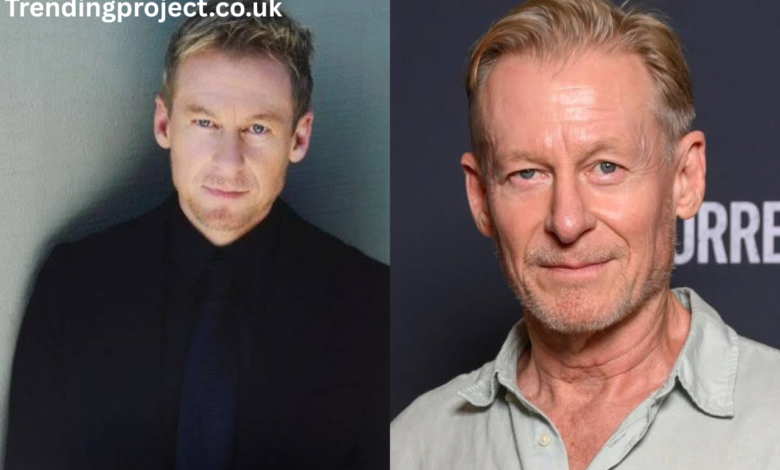
Richard Roxburgh is one of those actors whose career becomes more interesting the further you look beyond his most recognizable roles. International audiences may remember him as the flamboyant Duke in Moulin Rouge!, Dracula in Van Helsing, or Hugh Stamp in Mission: Impossible II, but those Hollywood performances represent only one part of a much larger career. Long before becoming familiar to global movie audiences, Roxburgh had established himself as a respected Australian stage and television actor, earning recognition for demanding dramatic performances and classical theatre roles.
Born on January 23, 1962, in Albury, New South Wales, Roxburgh did not follow a conventional route into entertainment. He studied economics at the Australian National University before eventually turning toward acting and gaining admission to the National Institute of Dramatic Art. That decision changed the direction of his life. From Australian theatre to acclaimed television dramas, Hollywood blockbusters, directing, writing and contemporary film, his career has continually expanded rather than remaining confined to one particular type of character.
In 2026, another important chapter was added to his story when Roxburgh won the AACTA Award for Best Lead Actor in Film for his performance as journalist Peter Greste in The Correspondent. The recognition was significant because it placed his work in a contemporary Australian film at the center of the country’s major screen awards. More than three decades after his professional career began, Roxburgh continues to demonstrate why versatility, theatrical discipline and a willingness to take creative risks have remained central to his longevity.
Richard Roxburgh Quick Facts
| Category | Details |
|---|---|
| Full Name | Richard Roxburgh |
| Date of Birth | January 23, 1962 |
| Age | 64 years old in 2026 |
| Birthplace | Albury, New South Wales, Australia |
| Nationality | Australian |
| Profession | Actor, Director, Writer and Producer |
| Education | Australian National University; National Institute of Dramatic Art |
| Degree | Bachelor of Economics |
| Parents | John Roxburgh and Mary Roxburgh |
| Siblings | Five siblings; youngest of six children |
| Wife | Silvia Colloca |
| Children | Three |
| Best Known For | Rake, Moulin Rouge!, Van Helsing, Mission: Impossible II, Blue Murder, The Correspondent |
| Major Recent Award | 2026 AACTA Award for Best Lead Actor in Film |
| Directorial Debut | Romulus, My Father |
| Estimated Net Worth | Public estimates vary; exact figure has not been publicly verified |
| No reliably confirmed official verified personal account identified | |
| X/Twitter | No reliably confirmed official personal account identified |
| No reliably confirmed official personal account identified |
Early Life and Family Background
Richard Roxburgh grew up in Albury in regional New South Wales as the youngest of six children. His childhood was far removed from the celebrity environment that would eventually surround his professional life. His father, John Roxburgh, worked extremely hard to support the family and at one point held three jobs, something Richard later remembered with a mixture of admiration and sadness because the demanding schedule limited the amount of time they could spend together.
That family experience appears to have influenced Roxburgh’s understanding of relationships and parenthood later in life. He has spoken about loving and admiring his father while also recognizing that financial responsibilities had created distance between them. One especially touching detail was that his father collected newspaper articles about Richard and created scrapbooks for him, providing a personal expression of affection despite the long working hours.
Roxburgh has described himself as a difficult and restless youngster who was frequently bored and searching for something that could capture his attention. Acting eventually provided that outlet. A school performance of Arthur Miller’s Death of a Salesman became an early turning point, giving him an experience of performance that stayed with him. What initially appeared to be a teenage interest gradually became a serious artistic direction.
Education and the Decision to Become an Actor
Roxburgh initially moved to Canberra to study economics at the Australian National University. He graduated with a Bachelor of Economics in 1984, but university life also helped him understand that a conventional professional career was unlikely to satisfy his creative ambitions. Although economics gave him an academic foundation, theatre was where he found genuine enthusiasm and a sense of purpose.
His involvement in university theatre eventually became more important to him than his academic studies. Roxburgh later reflected that acting was essentially the activity that brought him to life during his university years. That realization encouraged him to take the considerable risk of changing direction after completing his degree rather than simply continuing into an economics-related profession.
He auditioned for the National Institute of Dramatic Art, one of Australia’s most prestigious acting schools, and was accepted on his second attempt. After graduating from NIDA, he joined the Sydney Theatre Company and began building the theatrical foundation that would eventually distinguish him from many screen performers. His early professional development in theatre gave him experience with classical texts, demanding dialogue and live performance, all of which later became visible in his film and television work.
Richard Roxburgh’s Theatre Career
Theatre was the foundation of Roxburgh’s professional identity. One of his notable early achievements came in 1994 when he played Hamlet for Company B in Sydney. The production featured Jacqueline McKenzie as Ophelia and Geoffrey Rush as Horatio, with Cate Blanchett also associated with the production. Taking on Hamlet at that stage of his career demonstrated the seriousness with which Roxburgh approached classical acting.
His theatre career continued alongside his increasingly successful screen work. He appeared in productions including Toy Symphony, Waiting for Godot, Uncle Vanya, Cyrano de Bergerac, The Present and The Tempest. His performance in Toy Symphony earned him a Helpmann Award for Best Male Actor in a Play in 2008, while his work in Waiting for Godot brought another Helpmann Award in 2014.
Roxburgh’s theatre collaborations also placed him alongside some of Australia’s most respected performers. His work with Cate Blanchett and Hugo Weaving became particularly notable, and The Present, adapted from Chekhov’s Platonov, eventually moved from the Sydney Theatre Company to Broadway. This stage background helps explain the precision and vocal control that often distinguish Roxburgh’s screen performances.
Breakthrough With Blue Murder
One of Roxburgh’s major Australian television breakthroughs came with the 1995 miniseries Blue Murder. He portrayed Roger Rogerson, a controversial and corrupt detective, in a performance that demonstrated his ability to inhabit morally complicated characters. The role required considerably more than simply presenting a conventional television villain because the character was based on a real person and carried significant cultural and historical associations in Australia.
The performance earned Roxburgh both an AFI Award and a Logie Award for Best Actor, firmly establishing him as one of Australia’s leading television performers. The National Portrait Gallery identifies Blue Murder as one of the major milestones in his early screen career and places the performance among the roles that helped shape his reputation.
The success of Blue Murder also revealed an important quality that would recur throughout Roxburgh’s career. He was particularly effective when playing characters whose morality was complicated and whose personalities contained contradictions. Rather than simply portraying heroes or villains, he often found the humor, vulnerability, arrogance, intelligence or insecurity beneath the surface.
Hollywood Career and International Recognition
Roxburgh’s international breakthrough arrived around the beginning of the 2000s. In 2000 he appeared in Mission: Impossible II, starring Tom Cruise and directed by John Woo. The film introduced him to a much larger international audience and demonstrated that an actor whose reputation had been built largely in Australia could successfully transition into large-scale Hollywood productions.
A year later came one of his most recognizable roles: the Duke in Baz Luhrmann’s Moulin Rouge!. Starring Nicole Kidman and Ewan McGregor, the visually extravagant musical allowed Roxburgh to combine theatrical performance with cinematic excess. His Duke was sophisticated, powerful and threatening, giving the film one of its central antagonistic forces.
The role also strengthened his association with Baz Luhrmann, a connection that would continue later in his career. Roxburgh subsequently appeared as Moriarty in The League of Extraordinary Gentlemen and Count Dracula in Van Helsing. He also played Sherlock Holmes in The Hound of the Baskervilles. These roles established an international screen image built around commanding, theatrical and frequently antagonistic characters.
Dracula and His Famous Villain Roles
Count Dracula in Van Helsing became perhaps the role most closely associated with Roxburgh’s international genre-film reputation. Released in 2004 and starring Hugh Jackman, the film gave Roxburgh an opportunity to play one of popular culture’s most recognizable fictional villains. His performance leaned into Dracula’s theatricality, allowing him to use the expressive physicality and vocal control he had developed through years of stage work.
Although these blockbuster roles brought worldwide visibility, Roxburgh did not allow Hollywood villainy to become the definition of his entire career. He continued appearing in Australian productions, theatre projects and character-driven dramas. That balance was important because it allowed audiences to see him in radically different contexts.
His career consequently developed along two parallel tracks. International viewers might associate him with Dracula or the Duke, while Australian audiences continued to recognize him for serious television drama, comedy and theatre. This unusual combination gave Roxburgh a professional range that few performers maintain over such a long period.
Romulus, My Father and Directing
In 2007, Roxburgh expanded his creative career by directing Romulus, My Father, based on Raimond Gaita’s memoir. The film explored family, migration, hardship and the complex relationship between a father and son. Eric Bana starred in the film, which received substantial critical attention in Australia.
Directing represented a different kind of creative responsibility for Roxburgh. Instead of concentrating on one character, he had to consider performances, cinematography, editing, pacing and the emotional structure of the entire production. His experience as a stage actor gave him a strong understanding of performance, while his years in front of cameras provided insight into the demands of screen acting.
The film performed strongly at the 2007 AFI Awards, receiving recognition including Best Film, Best Lead Actor, Best Supporting Actor and the Young Actor’s Award. Roxburgh’s directorial work demonstrated that his interest in storytelling extended beyond acting and that he was capable of moving into another demanding area of filmmaking.
Rake and the Character of Cleaver Greene
For Australian television audiences, Richard Roxburgh may be most closely associated with Cleaver Greene, the brilliantly flawed barrister at the center of Rake. The series combined legal drama, comedy and character-driven storytelling, allowing Roxburgh to display a very different side of his acting ability from the intimidating villains he had played in Hollywood.
Cleaver Greene was intelligent, charismatic, irresponsible, self-destructive and frequently surrounded by personal disasters. The role required Roxburgh to move rapidly between comedy and serious drama, often within the same scene. It was a performance that depended heavily on timing, dialogue and the ability to make an imperfect character compelling.
Roxburgh also worked behind the scenes on Rake, including co-creating, writing and producing the Australian series. His performance earned major recognition, including a TV Week Silver Logie and an AACTA Award for Best Lead Actor in Television. The series ran for four seasons through 2016 and became one of the defining Australian television projects of his career.
Bob Hawke and Playing Real People
Another important aspect of Roxburgh’s career has been his work portraying real historical and public figures. One of his best-known examples was former Australian prime minister Bob Hawke. Roxburgh played Hawke in the television film Hawke, earning an AFI Award for Best Lead Actor in Television Drama.
Playing a recognizable public figure creates a different challenge from playing fictional characters. Audiences already have an image of the person, including their voice, mannerisms, public behavior and appearance. The actor therefore has to balance imitation with interpretation rather than simply reproducing an existing personality.
Roxburgh’s work as Hawke demonstrated his ability to transform physically and vocally while still creating a dramatic performance. His later portrayal of real-life journalist Peter Greste in The Correspondent would revisit this aspect of his craft, but in a much more contemporary setting.
Major Films and Television Projects
Beyond his most famous roles, Roxburgh’s filmography includes a wide range of Australian and international productions. His credits include Oscar and Lucinda, Thank God He Met Lizzie, Doing Time for Patsy Cline, Hacksaw Ridge, The Great Gatsby, Breath, Sanctum, Angel of Mine and H is for Happiness.
His television career has been similarly varied. He appeared in projects including East of Everything, The Hunting, Catherine the Great, Fires, Bali 2002, Prosper and other Australian and international productions. These projects allowed him to move between historical drama, family stories, social issues and contemporary television.
This variety is important when considering Roxburgh’s legacy. His career cannot be reduced to Hollywood films or Rake. He has repeatedly returned to Australian productions while maintaining relationships with international filmmakers. That movement between local and global entertainment has become one of the defining characteristics of his professional life.
Wife, Marriage and Children
Richard Roxburgh married Italian actress Silvia Colloca in 2004. The pair met while working on Van Helsing, where Roxburgh played Count Dracula and Colloca appeared as one of Dracula’s brides. Their professional relationship eventually developed into marriage, and they have three children together.
Colloca has built a career of her own as an actress, opera singer, television personality and cookbook author. The couple have generally maintained a relatively private family life despite both being public figures. They have lived in Sydney’s Northern Beaches, where Roxburgh has spoken about balancing professional commitments with the practical demands of raising children.
In a 2024 interview, Roxburgh discussed family life and the challenge of balancing acting, parenting and everyday responsibilities. He also reflected on his own relationship with his father and how that experience influenced his approach to fatherhood. The comments offered a more personal perspective on the actor behind the public career.
Richard Roxburgh’s Personality and Interests
Away from acting, Roxburgh has often presented himself as reflective and self-critical rather than someone who is completely satisfied with his own performances. In an interview with ABC, he described himself as being particularly hard on himself, suggesting that his approach to acting involves considerable self-evaluation.
He has also spoken about swimming and spending time around the Northern Beaches of Sydney. His conversations about family, home life and the pressures of modern digital culture suggest someone who values ordinary personal connections despite having spent much of his professional life in highly visible entertainment environments.
Another interesting part of his creative life is writing. Roxburgh authored the children’s adventure novel Artie and the Grime Wave, demonstrating once again that his creative interests extend beyond acting. Writing for children is a very different form of storytelling from Shakespearean theatre or dramatic television, but it fits naturally with his broader interest in creating characters and stories.
Richard Roxburgh Net Worth and Income
Richard Roxburgh’s precise net worth is not publicly documented through audited financial statements. Celebrity websites publish estimates, but those figures should be treated as approximate rather than established facts. His long career does, however, provide several identifiable professional sources of income, including film and television acting, theatre performances, directing, writing and producing.
His international films likely contributed substantially to his professional earnings, while his long-running Australian television work provided another important income stream. Projects such as Rake, where he also held creative and producing responsibilities, demonstrate that his work has not been limited to acting fees alone.
The most responsible way to discuss Richard Roxburgh’s finances is therefore to avoid presenting an estimated celebrity net-worth figure as fact. What can be established is that he has maintained a successful professional career across several decades and multiple areas of the entertainment industry.
Social Media and Public Presence
Unlike many contemporary actors, Richard Roxburgh has not built his career around an aggressive social-media presence. His public profile has traditionally been driven by films, television programs, theatre productions, interviews and industry events rather than constant online engagement.
There are social-media profiles using his name, but a reliably verified official personal Instagram, X/Twitter or LinkedIn account could not be established from the authoritative sources reviewed for this biography. Readers should therefore be careful when encountering accounts claiming to represent the actor, particularly when they request money, personal information or private communication.
His relatively restrained digital presence also fits the personality he has presented in interviews. Roxburgh tends to discuss his craft, family and professional projects rather than treating his private life as a continuous social-media product.
The Correspondent and His 2026 AACTA Award
One of the newest major achievements in Roxburgh’s career is his performance in The Correspondent. He portrays Australian journalist Peter Greste in the film, a role requiring him to dramatize the experiences of a real journalist whose imprisonment in Egypt became an international news story.
The project gave Roxburgh an opportunity to return to the kind of serious, character-driven storytelling that has appeared repeatedly throughout his career. Rather than relying on the exaggerated theatricality of Dracula or the comic energy of Cleaver Greene, the role required a more grounded portrayal of a real person facing an extraordinary situation.
In 2026, Roxburgh won the AACTA Award for Best Lead Actor in Film for The Correspondent. The film also received AACTA recognition for Production Design and Screenplay. The award added a new milestone to a career that has already included major Australian television and theatre honors.
Recent Career and Future Direction
Roxburgh’s career remains active rather than simply existing as a collection of past achievements. In recent years he has continued to work across Australian television, film and theatre, including projects such as Fires, Bali 2002 and Prosper. His career choices suggest that he remains interested in challenging dramatic material rather than depending entirely on the roles that originally made him famous.
Theatre continues to be part of his professional identity as well. His stage career has included major productions for the Sydney Theatre Company, and his history with Shakespeare, Chekhov and other demanding theatrical material remains an important part of his artistic reputation.
At this stage of his career, there is no need to define Roxburgh by one particular future project. His professional history suggests a willingness to move between mediums and genres. Whether through film, television, theatre, directing or writing, his continuing work demonstrates that his creative career is still evolving.
Richard Roxburgh’s Legacy
Richard Roxburgh’s journey from a young man in regional New South Wales to an internationally recognized actor is a story built on several turning points rather than one overnight breakthrough. He studied economics, discovered that theatre gave him the creative satisfaction he was missing, trained at NIDA and developed his craft on the Australian stage before becoming a major screen performer.
His most recognizable characters span remarkably different worlds: the corrupt detective Roger Rogerson in Blue Murder, the Duke in Moulin Rouge!, Dracula in Van Helsing, Cleaver Greene in Rake, Bob Hawke in Hawke and Peter Greste in The Correspondent. Each role required a different performance style, and together they illustrate the extraordinary range that has defined his career.
Perhaps the most meaningful lesson from Roxburgh’s career is that creative success does not always follow a straight line. His economics degree did not prevent him from becoming an actor, Hollywood success did not stop him from returning to Australian theatre, and international recognition did not keep him from exploring directing, writing and television. His 2026 AACTA Award for The Correspondent shows that even after decades in the industry, new achievements remain possible.
As Richard Roxburgh continues to work across Australian and international screen and stage productions, his story remains a reminder that longevity is built through curiosity, discipline and the willingness to keep learning. His career demonstrates how an individual can change direction, embrace unfamiliar challenges and continue developing long after achieving recognition. For future generations of performers, his journey offers an enduring example of how perseverance and passion can gradually become a meaningful creative legacy.