Rhonda Fleming Biography: The Life, Career, Movies, Family, Net Worth and Legacy of Hollywood’s “Queen of Technicolor”

Rhonda Fleming’s story begins with a teenager who never expected to become a Hollywood actress. Born Marilyn Louis in Hollywood in 1923, she originally dreamed of becoming a professional singer rather than a movie star. Then, while she was still attending Beverly Hills High School, a talent agent noticed her and opened a door that would change the direction of her life. Within only a few years, she was appearing alongside major stars and working with legendary filmmakers, including Alfred Hitchcock.
Table of Contents
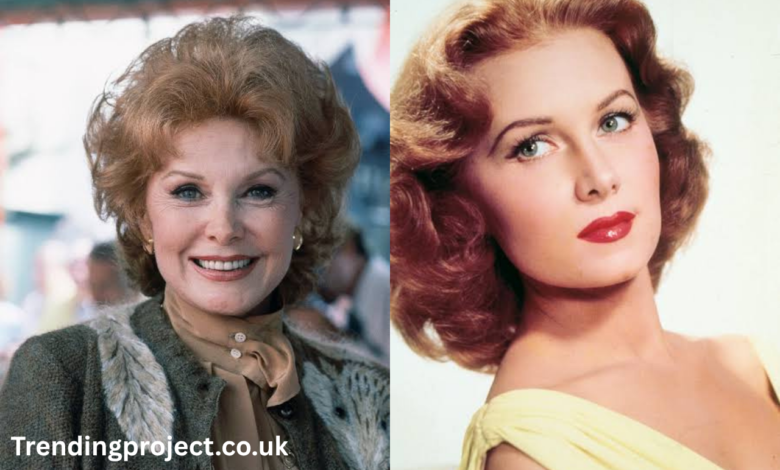
ToggleWhat made Fleming particularly memorable was not simply her beauty, although her auburn hair, light complexion and striking eyes made her one of the most visually distinctive actresses of Hollywood’s Golden Age. Her appearance became especially dramatic in Technicolor, earning her the famous nickname “Queen of Technicolor.” Yet her career was much broader than that nickname suggests. She worked in film noir, westerns, musicals, adventure films, television and theater, while also developing a successful career as a singer and stage performer.
Behind the glamorous image was a woman whose life included professional setbacks, multiple marriages, personal loss and eventually a profound commitment to philanthropy. After her sister Beverly died from ovarian cancer, Fleming devoted considerable energy to improving the experience of cancer patients, helping establish a resource center at UCLA that emphasized compassion, communication, information and emotional support. Her later humanitarian work became one of the most meaningful parts of her legacy.
Rhonda Fleming’s Early Life and Family Background
Rhonda Fleming was born Marilyn Louis on August 10, 1923, in Hollywood, California. Her father, Harold Cheverton Louis, worked in insurance, while her mother, Effie Graham, had a background in entertainment as an actress and model. Fleming therefore grew up with at least some exposure to the world of performance, although becoming a Hollywood actress was not initially the ambition that dominated her teenage years.
Her mother’s entertainment background was particularly notable. Effie Graham had performed on the New York stage and had appeared opposite Al Jolson, giving young Marilyn an unusual connection to the theatrical world. Fleming herself was more interested in singing and reportedly admired vocalist and actress Deanna Durbin. She received voice training and participated in singing contests, developing skills that would eventually become an important secondary part of her professional career.
Fleming attended Beverly Hills High School and graduated in 1941. She was also active in athletics, participating in school basketball and volleyball, which offers an interesting contrast to the glamorous image later associated with her. Her youth was therefore shaped by several interests—music, school activities, athletics and the growing entertainment culture surrounding Los Angeles.
How Marilyn Louis Became Rhonda Fleming
Fleming’s entry into Hollywood was remarkably sudden. While she was still a teenager attending Beverly Hills High School, talent agent Henry Willson noticed her. Willson became known for discovering and developing several performers, and he saw commercial potential in the young Marilyn Louis. According to accounts of Fleming’s life, she was signed without even going through a conventional screen test.
The transformation from Marilyn Louis into Rhonda Fleming was part of the old Hollywood studio system, where young performers were frequently given new names and carefully shaped public identities. The name “Rhonda Fleming” was selected for its commercial appeal, while the studio system helped develop her image and introduce her to audiences. Fleming later described her discovery as something resembling a Cinderella story—an extraordinary opportunity that arrived before she had even fully understood what professional acting would involve.
Her first years in Hollywood were therefore a mixture of opportunity and uncertainty. She had little traditional acting experience and was suddenly being placed in professional productions. Her own recollections of those early years reveal how inexperienced she was when she first entered the industry. That innocence makes her rapid rise especially remarkable because she had to learn the demands of filmmaking while simultaneously building a public identity that would soon become internationally recognizable.
Rhonda Fleming’s Breakthrough With Alfred Hitchcock
Fleming’s first substantial screen role came in Alfred Hitchcock’s 1945 psychological thriller Spellbound. The film starred Gregory Peck and Ingrid Bergman and placed Fleming in the company of major Hollywood talent almost immediately. Her appearance as Mary Carmichael gave her an opportunity to work under one of cinema’s most influential directors while still being at the beginning of her career.
The story surrounding the role became one of the most memorable anecdotes in Fleming’s biography. She was reportedly told she would play a character described using terminology she did not understand. Fleming later recalled having to go home and look up the word with her mother. The episode perfectly captures how young and inexperienced she was when Hollywood suddenly placed her in sophisticated adult productions.
Rather than becoming a one-film curiosity, Fleming used Spellbound as a stepping stone. She followed it with appearances in Robert Siodmak’s The Spiral Staircase and the western Abilene Town. These early films allowed her to demonstrate that she could work within different genres and helped establish her as a dependable young performer rather than simply another attractive newcomer.
Rhonda Fleming and Out of the Past
One of the most important films in Fleming’s career came in 1947 with Jacques Tourneur’s Out of the Past. Starring Robert Mitchum, the film eventually became one of the defining works of American film noir. Fleming played Meta Carson, a character whose involvement in the story contributes to the deception and danger surrounding Mitchum’s private detective.
The role was significant because it demonstrated a side of Fleming that could easily be overlooked when discussing her Technicolor image. In black-and-white film noir, she was not simply presented as a colorful Hollywood beauty. Instead, she became part of a darker cinematic world built around deception, betrayal, crime and moral ambiguity. Her work in the film helped establish her credibility within a genre that remains highly respected by film historians.
Fleming later expressed some frustration that her appearance in Technicolor often encouraged producers to use her primarily for glamorous roles. She believed that her black-and-white performances sometimes offered stronger opportunities to demonstrate her acting abilities. This tension between image and talent became one of the recurring themes of her career and helps explain why Out of the Past remains so important when evaluating her work.
Becoming Hollywood’s “Queen of Technicolor”
Fleming’s transformation into a Technicolor star accelerated during the late 1940s and 1950s. Her first Technicolor film was A Connecticut Yankee in King Arthur’s Court, the 1949 musical starring Bing Crosby. The vivid color process emphasized her auburn hair and distinctive features, creating an appearance that was almost tailor-made for the visual spectacle of Technicolor cinema.
The nickname “Queen of Technicolor” became closely associated with her. The title captured how audiences and studios perceived her visual appeal, but Fleming herself was not always enthusiastic about being defined by it. She wanted recognition for being a working actress rather than merely a glamorous image created by Hollywood publicity.
Her Technicolor image nevertheless became an important part of classic Hollywood history. During an era when color filmmaking itself was a major attraction, stars who photographed exceptionally well could become central to the marketing of movies. Fleming’s appearance helped make her particularly suitable for westerns, adventure films, historical dramas and musicals, genres in which color photography could become part of the entertainment experience itself.
Rhonda Fleming’s Major Movies and Hollywood Career
During the 1950s, Fleming appeared in a steady stream of movies and worked with many of Hollywood’s leading men. Her filmography included The Golden Hawk, The Last Outpost, Tropic Zone, Serpent of the Nile, Pony Express, Inferno, Those Redheads from Seattle, Jivaro, Yankee Pasha, Slightly Scarlet, While the City Sleeps and Gunfight at the O.K. Corral.
Her co-stars included Bing Crosby, Bob Hope, Gregory Peck, Robert Mitchum, Rock Hudson, Charlton Heston, Kirk Douglas, Burt Lancaster and Ronald Reagan. She appeared with Reagan in four films, creating a professional relationship that became one of the notable connections of her career. Her ability to move between established stars and different genres demonstrated how effectively she had adapted to the demands of Hollywood.
Not every film received the same critical recognition, and Fleming herself later acknowledged that some of her choices were influenced by the financial opportunities available to her. She believed that accepting lesser films for good money sometimes prevented her from securing more substantial dramatic roles. Nevertheless, the sheer volume and variety of her work established her as a true Hollywood professional who remained active through changing trends in the movie industry.
Gunfight at the O.K. Corral and Her Western Roles
Among Fleming’s most recognizable movies was Gunfight at the O.K. Corral, released in 1957. The film starred Burt Lancaster as Wyatt Earp and Kirk Douglas as Doc Holliday and became one of the best-known westerns of its period. Fleming played Laura Denbow, giving her a role in a major production surrounded by two of Hollywood’s most famous actors.
The western genre was particularly compatible with Fleming’s screen image. Her striking appearance made her immediately memorable, while her confidence allowed her to play women who were more than passive romantic figures. Across her western performances, she was repeatedly placed in stories involving danger, adventure, romance and conflict—characteristics that helped sustain her popularity during the 1950s.
Her western career also reflected the commercial realities of the period. Studios produced large numbers of westerns because they were popular with audiences, and Fleming became one of the actresses whose presence could add glamour and star appeal to those productions. Although some of these films were less prestigious than the major noir pictures in which she had appeared, they kept her consistently employed during one of the busiest periods of her career.
Rhonda Fleming’s Singing and Stage Career
Acting was only one part of Fleming’s artistic identity. Her early ambition had been to become a singer, and she eventually found a way to incorporate that dream into her professional life. Her singing ability became particularly visible in A Connecticut Yankee in King Arthur’s Court, where she performed with Bing Crosby.
In 1957, Fleming made an important transition from movie star to live entertainer when she launched a nightclub act at the Tropicana in Las Vegas. Her performance received strong attention and gave her the opportunity to demonstrate that she could command an audience without the assistance of a film camera, elaborate movie sets or another actor sharing the scene.
Her stage career continued with appearances at the Hollywood Bowl and eventually Broadway. In 1973, she appeared in a revival of Clare Boothe Luce’s The Women. She also performed in productions associated with Kismet and continued working as a singer and entertainer. This part of her career is important because it shows that Fleming’s artistic abilities extended beyond the glamorous movie-star persona that Hollywood had created around her.
Rhonda Fleming’s Television Career
As the Hollywood studio system changed, Fleming increasingly turned to television. She appeared in a wide range of popular programs, including Death Valley Days, Wagon Train, Burke’s Law, The Virginian, McMillan & Wife, Police Woman, Kung Fu and The Love Boat. Television offered her a way to remain visible and professionally active as feature-film opportunities became less predictable.
Her television work also demonstrated the durability of her celebrity. By appearing on popular network programs, Fleming was able to introduce herself to audiences who may have known her less from recent movies and more from her earlier Hollywood career. Television became a bridge between classic Hollywood and the newer entertainment landscape that emerged during the 1960s and 1970s.
Although her screen work gradually became less frequent, Fleming did not disappear from public life. She continued performing, making appearances and supporting charitable organizations. Her professional identity gradually shifted from full-time actress toward entertainer, public figure and philanthropist, setting the stage for one of the most meaningful transformations of her later life.
Rhonda Fleming’s Marriages and Family Life
Fleming married six times during her life. Her first husband was Thomas Lane, whom she married while still very young. The couple had one son, Kent Lane. Her later husbands included physician Lewis Morrill, actor Lang Jeffries, producer-director Hall Bartlett, theater executive Ted Mann and businessman Darol Wayne Carlson.
Her marriage to Ted Mann was particularly significant because it lasted for roughly 23 years, until his death in 2001. Mann was associated with the Mann Theatres chain, and the couple eventually became known not only for their entertainment-industry connections but also for their philanthropic activities. Fleming’s relationship with Mann coincided with the period when her charitable work became increasingly central to her life.
Fleming later married Darol Wayne Carlson, who died in 2017. Through her son Kent, she became a grandmother and great-grandmother, and family became an important part of her later years. Although her marriages received attention during her Hollywood career, the later chapters of her life increasingly centered on family, philanthropy and service rather than celebrity publicity.
The Loss of Her Sister and Rhonda Fleming’s Cancer Advocacy
The death of Fleming’s older sister Beverly from ovarian cancer profoundly changed her life. Fleming had been deeply involved in supporting her sister during her illness, and the experience exposed her to shortcomings in the emotional and psychological support available to cancer patients and their families. That experience eventually inspired Fleming to take action rather than simply mourn her loss.
Together with Ted Mann, Fleming helped establish the Rhonda Fleming Mann Resource Center for Women with Cancer at UCLA. The center was envisioned as a welcoming place where women could obtain information and support in a compassionate environment. Fleming wanted cancer care to address the whole person rather than focusing exclusively on medical treatment.
Her philosophy centered on what she described as four important qualities: caring, concern, compassion and communication. The UCLA Alumni Association recognized her with its 2000 University Service Award, while other organizations honored her humanitarian work. In this stage of her life, Fleming used the fame and resources acquired through Hollywood to create something much more enduring than another film credit.
Rhonda Fleming’s Philanthropy Beyond Cancer Care
Cancer advocacy was not Fleming’s only charitable interest. The Television Academy notes that later in life she supported organizations dealing with cancer, homelessness and child abuse. She also participated in efforts supporting people who faced difficult circumstances outside the medical system. Her philanthropy therefore reflected a broader concern for vulnerable people rather than a single charitable cause.
She was particularly committed to the idea that compassion should be practical. Her charitable work involved fundraising, public advocacy, organizational support and direct involvement. At UCLA, for example, she participated in educational events and helped promote access to information about cancer treatment and patient support.
Her humanitarian achievements eventually became an important part of how institutions remembered her. The Concern Foundation named her Humanitarian of the Year in 1999, and she received the Women’s International Center Living Legacy Award. City of Hope also recognized her as Woman of the Year on more than one occasion. These honors demonstrate that her later reputation was based not simply on nostalgia for her Hollywood career but on tangible service to others.
Rhonda Fleming’s Awards and Hollywood Recognition
One of Fleming’s most visible honors is her Hollywood Walk of Fame star. Her star was dedicated on February 8, 1960, at 6660 Hollywood Boulevard in the motion-picture category. The honor came during a period when she was still strongly associated with the major stars and productions of Hollywood’s Golden Age.
Her Walk of Fame recognition reflects the entertainment side of her legacy. She appeared in more than 40 films, numerous television programs and stage productions, making her one of the working actresses who helped define the transition from the classic studio era into the television age. Her career was not based on one blockbuster but on decades of consistent professional work.
Her humanitarian honors added another dimension to that legacy. UCLA’s University Service Award and her recognition by cancer-support organizations show that her accomplishments later extended far beyond entertainment. The combination of Hollywood recognition and humanitarian honors makes Fleming’s biography unusual: she became famous because of cinema, but she ultimately became respected for what she chose to do with her fame.
Rhonda Fleming’s Net Worth and Sources of Income
Estimates of Rhonda Fleming’s net worth vary across celebrity-focused websites, and there is no reliable public financial statement that establishes an exact figure. For that reason, any specific net-worth number should be treated as an estimate rather than a verified fact. Her financial position was influenced by a long entertainment career, business and real-estate interests, and her marriage to Ted Mann, who was a successful theater entrepreneur.
During her active career, Fleming earned income from film contracts, television appearances, stage performances, nightclub engagements and music-related work. Her ability to move between these fields gave her several professional income streams rather than relying entirely on movie salaries. She also reportedly developed an interest in real-estate investments, which helped her maintain financial independence after the studio era began to decline.
However, it would be misleading to reduce Fleming’s life to a discussion of wealth. The later decades of her life demonstrate that she was increasingly interested in using her public position and resources to support charitable causes. Her financial success gave her opportunities, but her philanthropic work showed how she chose to use those opportunities for purposes beyond personal luxury or celebrity status.
Rhonda Fleming’s Social Media and Digital Legacy
Rhonda Fleming belonged to a generation of performers whose careers existed almost entirely before social media. Instagram, Facebook, X and LinkedIn were created decades after she had already established herself as a Hollywood star. Consequently, there is no reliable basis for attributing modern social-media accounts to Fleming herself, and unofficial fan pages should not be confused with verified personal profiles.
Her presence today is instead preserved through digital film archives, Hollywood history websites, streaming platforms, classic-film communities and social-media posts shared by fans and film historians. Photographs from her Technicolor movies continue to circulate online, while films such as Out of the Past, A Connecticut Yankee in King Arthur’s Court and Gunfight at the O.K. Corral continue introducing new generations to her work.
In that sense, Fleming’s online legacy is unusual but powerful. She does not need to maintain a daily social-media presence to remain culturally relevant. Her photographs, performances, interviews and humanitarian achievements have become the content through which modern audiences encounter her. Her career demonstrates how a performer from the pre-internet era can continue to attract interest long after her final screen appearance.
Rhonda Fleming’s Final Years and Death
Fleming gradually stepped away from acting during the later decades of her life. Her final feature-film appearance came in The Nude Bomb in 1980, although she later appeared in Waiting for the Wind in 1990. The latter was particularly meaningful because it reunited her with Robert Mitchum, her co-star from Out of the Past more than four decades earlier.
By this point, Fleming’s attention was increasingly directed toward charitable work. She remained involved with cancer advocacy and other social causes and became an important public supporter of organizations helping patients and vulnerable communities. Her transition away from entertainment was therefore not simply retirement; it was a redirection of energy toward causes that had acquired deep personal significance.
Rhonda Fleming died on October 14, 2020, in Santa Monica, California, at the age of 97. Reports stated that she died in a Santa Monica hospital, with complications from aspiration pneumonia cited by the Washington Post. Her death marked the passing of one of the distinctive stars of Hollywood’s Golden Age and one of the last performers whose career had begun inside the classic studio system.
Rhonda Fleming’s Lasting Legacy
Rhonda Fleming’s place in film history rests partly on her extraordinary visual identity. Her red hair and striking eyes made her almost synonymous with Technicolor glamour, but her career was much more complicated than the nickname “Queen of Technicolor” suggests. Her performances in Out of the Past, The Spiral Staircase, Slightly Scarlet, Home Before Dark and other films revealed an actress capable of working within darker and more demanding material.
She also represents the resilience of the Hollywood working actor. Fleming did not build her reputation around a handful of universally celebrated films. Instead, she remained active across more than 40 movies, television productions, live performances and stage appearances. Film historian Jeanine Basinger described her career as that of a professional who endured and could appear successfully in many different kinds of movies.
Most importantly, Fleming’s legacy extends beyond the screen. The work she undertook after her sister’s illness transformed personal grief into a mission to help other women facing cancer. The UCLA resource center became a physical expression of that philosophy, while her broader charitable involvement demonstrated that her understanding of success had changed over time.
Conclusion: The Enduring Story of Rhonda Fleming
Rhonda Fleming’s journey is a remarkable example of how a life can develop in directions that no one could predict at the beginning. She started as Marilyn Louis, a teenager who dreamed of singing, and unexpectedly entered Hollywood after being discovered while attending high school. From there, she became an internationally recognized actress, worked alongside some of the biggest stars of her generation and earned a permanent place on the Hollywood Walk of Fame.
Her career was filled with contradictions. She was celebrated for her beauty but wanted to be appreciated for her professionalism. She became famous for Technicolor productions but valued the deeper acting opportunities she found in black-and-white films. She experienced the privileges of Hollywood success while also enduring personal and professional disappointments. Instead of allowing those experiences to define the rest of her life, she continually found new ways to reinvent herself.
Ultimately, the most inspiring chapter of Rhonda Fleming’s biography may have come after her greatest years of movie stardom. The death of her sister introduced her to the painful reality of cancer care, and Fleming responded by helping create resources designed to give patients compassion, dignity, information and hope. That transformation from actress to philanthropist gives her story a significance that reaches beyond classic Hollywood.
Rhonda Fleming died at 97, but the two sides of her legacy remain connected. The actress continues to live through the films that made her famous, while the philanthropist is remembered through the causes she supported and the lives she touched. Her story is ultimately a reminder that fame can open a door, talent can build a career, but purpose is what can turn a career into a lasting legacy. As future generations rediscover Hollywood’s Golden Age, Rhonda Fleming’s journey stands as an enduring example of resilience, reinvention, compassion and the power of using one’s success to create hope for others.