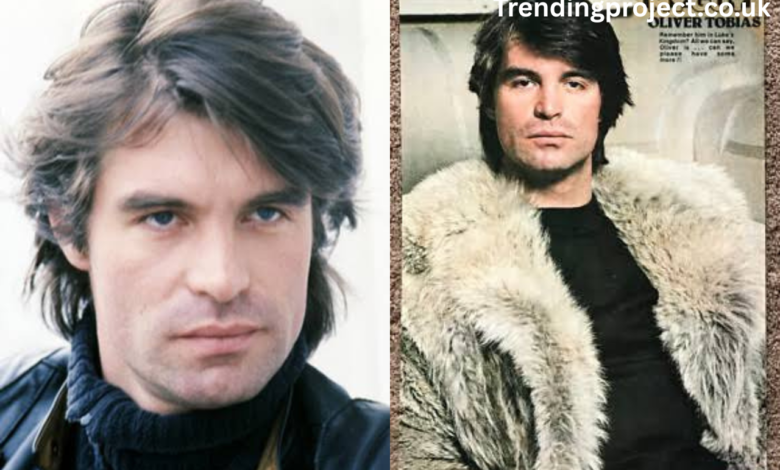
Oliver Tobias has one of those careers that seems to belong to several different eras of entertainment at once. Born in Zürich, Switzerland, in 1947, he grew from the son of two accomplished European actors into a performer who became a familiar face on British television, a leading man on the stage and screen, and one of the most recognisable male stars of 1970s popular culture. His career reached a defining point when he played King Arthur in Arthur of the Britons, while his appearance opposite Joan Collins in The Stud gave him a very different kind of celebrity. Yet neither role completely explains the breadth of his professional life. Tobias has also worked in musical theatre, classical theatre, film, opera, television and directing, making his career considerably more varied than the “70s heart-throb” label sometimes suggests.
What makes Oliver Tobias particularly fascinating is the way he repeatedly resisted being confined to one image. He entered professional theatre through the revolutionary musical Hair, played Judas in Jesus Christ Superstar, appeared in international films, became a television adventure star, performed at London’s Drury Lane Theatre and later took on demanding classical and operatic roles. His own comments in a 2002 interview revealed that he was aware of the gap between the public image created by The Stud and the much broader range of interests that shaped his artistic life.
For audiences discovering Oliver Tobias today, his story is therefore more than a nostalgic look at a handsome television star from the 1970s. It is the story of a performer who entered show business at a moment when British theatre and television were changing rapidly, found early fame through unconventional productions, and then spent decades exploring different forms of performance. His journey offers an interesting lesson in reinvention, artistic curiosity and the importance of refusing to let one successful role define an entire career.
Oliver Tobias Quick Facts
| Fact | Details |
|---|---|
| Full birth name | Oliver Tobias Freitag |
| Professional name | Oliver Tobias |
| Date of birth | August 6, 1947 |
| Age | 79 in 2026 |
| Birthplace | Zürich, Switzerland |
| Profession | Actor, director and writer |
| Father | Robert Freitag |
| Mother | Maria Becker |
| Education | East 15 Acting School |
| Early dance training | Ecole de Dance, Zürich |
| Major breakthrough | Hair and Arthur of the Britons |
| Best-known television role | King Arthur |
| Best-known film role | Mike in The Stud |
| Other notable work | Luke’s Kingdom, Smuggler, Arabian Adventure, The Pirates of Penzance |
| Spouse | Arabella Zamoyska |
| Previous marriage | Camilla Ravenshear |
| Net worth | No reliable publicly verified figure |
| No clearly verified official account located | |
| X/Twitter | No clearly verified official account located |
| No clearly verified personal account located | |
| Years active | More than five decades |
The basic biographical record establishes that Oliver Tobias was born Oliver Tobias Freitag on August 6, 1947, in Zürich. IMDb identifies him as the son of Swiss actor Robert Freitag and German actress Maria Becker and records that he moved to England when he was eight years old. His professional name was shortened to Oliver Tobias, with Hair marking the beginning of his major London theatre career.
Tobias’s career has stretched across several generations of entertainment. His credits include stage productions, British television dramas, international cinema, musical theatre and opera. IMDb currently identifies him as an actor, director and writer, while contemporary theatre coverage has repeatedly highlighted the variety of his work rather than limiting him to his most commercially famous roles.
There is considerably less reliable information available about his private finances and present-day social-media activity. Internet celebrity websites sometimes publish precise net-worth estimates, but these figures are not supported by publicly available financial records. A responsible biography should therefore distinguish between documented career achievements and speculative claims about personal wealth.
Early Life and Family Background
Oliver Tobias was born into a family in which acting was already an established profession. His father, Robert Freitag, was a Swiss actor, while his mother, Maria Becker, was a German actress. Growing up around professional performers gave Tobias an unusually early exposure to the theatre and to the realities of an actor’s working life. Rather than discovering the entertainment industry from a distance, he encountered it through his own family.
His parents later divorced, and Tobias moved to England when he was eight. According to biographical accounts, his mother encouraged his artistic development and he eventually entered formal acting training. The move from Switzerland to Britain was an important turning point because it placed him within the British cultural environment that would later become the foundation of his professional career. He attended boarding school before pursuing drama and dance training.
Tobias studied at East 15 Acting School between 1965 and 1968 while also undertaking dance training in Zürich. That combination of acting and physical performance became particularly useful when he entered musical theatre. His early preparation helps explain why he was able to move comfortably between straight drama, rock musicals, adventure productions and physically demanding television roles. His background was theatrical, but his ambitions were never restricted to one narrow form of acting.
Education and the Beginning of His Career
The late 1960s were a remarkable period for British theatre. Traditional stage productions were increasingly sharing space with experimental drama, rock music and youth-oriented counterculture, and Hair became one of the defining productions of that transformation. Tobias’s involvement with the original London production in 1968 gave him an extraordinary professional opportunity almost immediately after completing his formal training. He played Berger, one of the musical’s principal rebellious characters.
His relationship with Hair was not limited to acting. Biographical sources record that he subsequently starred in, staged and choreographed the production in Amsterdam and later directed a production in Tel Aviv. This is an important part of his career because it shows that Tobias developed an interest in the creative side of theatre from a very early stage. He was learning how performances were built rather than simply concentrating on his own role.
He continued his musical-theatre journey by playing Judas in a German touring production of Jesus Christ Superstar. These early experiences gave him a strong foundation in physical stage performance and helped establish the charismatic presence that later translated so effectively to television. By the beginning of the 1970s, Tobias was already more than a promising young actor; he had demonstrated experience as a performer, choreographer and director.
Oliver Tobias and Arthur of the Britons
The role that changed Oliver Tobias’s public profile most dramatically was King Arthur in Arthur of the Britons. The British television series premiered in 1972 and ran for two series and 24 episodes. Unlike many romanticised versions of the Arthurian legend, the programme presented a rougher, more grounded world of tribal conflict, political rivalry and swordplay. Tobias played Arthur as a Celtic leader rather than the polished medieval king familiar from later fantasy adaptations.
The series was particularly effective at matching Tobias’s physical screen presence with the adventurous atmosphere of the production. Contemporary retrospective accounts describe the programme’s gritty locations, woodland battles and relatively realistic approach to the so-called Dark Ages. Tobias’s appearance and performance helped make the series memorable for a generation of British television viewers.
The importance of Arthur of the Britons to Tobias’s career cannot be overstated. In his later interview with WhatsOnStage, Tobias described the series as a major break in terms of popularity, noting that television made actors widely known. The programme transformed him from a respected young theatrical performer into a recognisable television personality, while also creating an association with adventure roles that followed him through much of the decade.
Luke’s Kingdom and Television Stardom
After Arthur of the Britons, Tobias continued to build his television reputation through Luke’s Kingdom. Directed by Australian filmmaker Peter Weir, the series provided another opportunity for Tobias to play a strong central character in an adventure setting. His growing popularity meant that television audiences increasingly recognised him as a leading man capable of carrying dramatic and action-oriented productions.
His television work during this period also included appearances in productions drawing on famous historical and literary characters. The combination of period settings, adventure storytelling and Tobias’s distinctive appearance became a recurring feature of his screen career. He was particularly well suited to productions requiring an actor who could communicate authority while also bringing an element of youthful energy to the role.
The success of these shows coincided with a period in which British television could turn actors into household names with remarkable speed. Tobias’s experience demonstrates how different the celebrity landscape was before social media. His fame was created by television broadcasts, theatre publicity, magazines and cinema rather than Instagram or online fan communities. His image was therefore shaped largely by the roles he played and the way newspapers and entertainment magazines presented him.
Film Career and International Productions
Tobias’s film career developed alongside his television success. One of his early major film appearances was Romance of a Horsethief, an international production featuring performers including Yul Brynner, Serge Gainsbourg and Eli Wallach. He subsequently appeared opposite Charlotte Rampling in Giuseppe Patroni Griffi’s ‘Tis Pity She’s a Whore. These projects gave him experience working with internationally recognised actors and directors at an early stage of his screen career.
His filmography expanded through a mixture of historical adventures, dramas and commercial productions. Among the titles associated with his career are The God King, King Arthur, the Young Warlord, Arabian Adventure, The Wicked Lady, A Nightingale Sang in Berkeley Square, Mata Hari, Cobra Mission and The Brylcreem Boys. The variety of these productions demonstrates that Tobias did not follow a single genre throughout his career.
His ability to move between international cinema and British television also helped preserve his career beyond the peak of his 1970s fame. Rather than depending entirely on one market, Tobias accumulated experience across different production environments. That international dimension is one of the less frequently discussed aspects of his biography but an important reason his filmography is so varied.
The Impact of The Stud
In 1978, Tobias appeared opposite Joan Collins in The Stud, a film that became one of the defining projects of his popular image. The production gave him a much more overtly sensual screen persona and contributed significantly to his reputation as one of the leading male sex symbols of the decade. Contemporary coverage repeatedly linked Tobias with this image, sometimes more strongly than he himself felt it represented his artistic identity.
The popularity of The Stud meant that Tobias became the subject of considerable fan attention. A contemporary 1979 profile described admirers sending letters and even approaching him through restaurants, illustrating the intensity of celebrity culture around him at the time. The same article connected his screen persona with the swashbuckling image created by Arthur of the Britons and other adventure productions.
Interestingly, Tobias did not appear embarrassed by being regarded as a sex symbol. In his 2002 interview with WhatsOnStage, he said he was comfortable with the label while also making clear that it did not represent the entirety of his personality or ambitions. He regarded the public fascination with the image as relatively harmless and remained more interested in the variety of work he was able to pursue.
Breaking Away From the Heart-Throb Image
One of the most compelling aspects of Tobias’s career is his willingness to challenge the expectations created by his appearance and early success. After becoming famous as a handsome television adventurer and through The Stud, he continued accepting roles that required different skills. He appeared in theatre, opera, serious drama and productions that were far removed from the image of the romantic leading man.
His stage work included the Pirate King in The Pirates of Penzance at London’s Theatre Royal Drury Lane, a role that demonstrated his ability to return to musical theatre at a major West End venue. He also appeared as Bassa Selim in Mozart’s The Abduction from the Seraglio, including work associated with the Royal Opera House.
This willingness to experiment became an important part of his identity as a performer. Tobias himself explained that audiences sometimes did not understand where he was “coming from” because the popular press had created such a strong image around The Stud. His response was essentially to continue doing the work that interested him. That attitude allowed him to build a career with much greater variety than his best-known screen roles might initially suggest.
Theatre, Opera and Creative Work
The stage remained an important part of Tobias’s career long after television fame arrived. He performed in musical productions, classical theatre and major West End projects, including La Cava, The Boy Friend and Footloose. In his 2002 interview, he spoke warmly about theatre actors and described live performance as an unusually exposed form of work because performers cannot hide behind a camera or another instrument.
His involvement with opera was especially revealing. Playing Bassa Selim in Mozart’s The Abduction from the Seraglio represented a significant departure from the adventure and romantic roles that had made him famous. Tobias’s ability to move into this world demonstrated that his artistic interests were broader than commercial film and television. It also reflected the versatility developed during his early musical-theatre training.
He later returned to productions connected with Mozart, as well as other theatrical projects. His career consequently developed into a mixture of screen acting and stage performance rather than following a conventional path from television fame to retirement. That continuing connection with live theatre is central to understanding Oliver Tobias as a performer.
Personal Life and Family
Oliver Tobias has generally maintained a comparatively private approach to his personal life. Public biographical sources record his earlier marriage to Camilla Ravenshear and his later marriage to Arabella Zamoyska in 2001. Because publicly available databases differ in some of the details concerning his family, it is safer to concentrate on information that is consistently documented rather than repeat uncertain claims about his children or private household.
His family background remained an important part of his identity even after he became famous in his own right. Being the son of Robert Freitag and Maria Becker placed him within a European theatrical tradition, but his professional achievements were developed independently through British drama training and years of practical work. His career therefore combines inherited artistic influence with a distinctly personal professional identity.
Tobias’s interviews also suggest a performer who has never been entirely comfortable with being reduced to celebrity status. His comments about the entertainment press and his preference for varied work reveal someone more interested in acting itself than in maintaining a carefully manufactured public persona. That attitude may partly explain why his private life has remained considerably less visible than his professional work.
Oliver Tobias Net Worth and Income
There is no authoritative public source that establishes Oliver Tobias’s current net worth. Celebrity websites sometimes publish exact estimates, but such numbers generally do not provide audited financial information about actors’ assets, investments, property, royalties or private contracts. For that reason, claims that Tobias is worth a specific multimillion-dollar amount should be treated as estimates rather than established facts.
His income over the decades would have come from several professional areas. These include film acting, television acting, theatre performances, musical productions, directing and other creative work. A career extending for more than five decades naturally provides multiple opportunities to earn income, but the absence of public financial statements means it is impossible to calculate his present wealth accurately.
The more meaningful financial measure is therefore career longevity rather than an invented net-worth figure. Tobias has worked across entertainment markets and remained associated with productions that continue to generate interest decades after their original release. His enduring screen catalogue, theatre career and reputation as a versatile performer represent the professional foundation behind whatever private financial success he may have achieved.
Social Media and Public Presence
Oliver Tobias belongs to a generation of performers whose careers were established long before digital platforms transformed celebrity communication. Unlike many younger actors, he does not appear to have a clearly verified, widely maintained Instagram, X or LinkedIn presence that can confidently be identified as his official account. Unverified social profiles should therefore not automatically be presented as belonging to him.
This relative lack of online visibility is actually an interesting part of his modern legacy. Audiences today can discover Tobias through streaming platforms, online film databases, archival interviews and social-media discussions even though he did not build his career through the internet. His fame has effectively crossed from the pre-digital entertainment era into the digital age through the survival of his performances.
His most effective connection with audiences remains his work itself. Viewers who encounter Arthur of the Britons, The Stud, Hair or his other productions can experience the performance without requiring a contemporary influencer-style online presence. In that sense, Tobias’s career demonstrates the lasting power of recorded performance.
Later Career and Continuing Work
Oliver Tobias continued acting well beyond the period in which he became famous. His later credits include television and film projects such as The Brylcreem Boys, Method, Sharpe’s Waterloo and other productions. He also continued his theatre work, demonstrating that his professional life did not simply end when the 1970s celebrity cycle moved on to younger stars.
One particularly interesting aspect of his later career was his continued willingness to move between countries and artistic traditions. His work included German and Swiss television as well as British theatre and international productions. This international dimension reflected the European background with which he began his career and allowed him to maintain professional relationships outside Britain’s mainstream entertainment industry.
There is limited reliable evidence for a major new project specifically announced for 2026, so it would be misleading to claim that Tobias currently has a particular film or television series in production without confirmation. What can be said with confidence is that his established body of work continues to attract interest, and his career remains notable for its unusual longevity and variety.
Legacy and Influence
Oliver Tobias’s most obvious legacy is connected with Arthur of the Britons. The series remains remembered for its darker and more grounded interpretation of Arthurian legend, and Tobias’s portrayal of Arthur became an important part of that identity. Unlike later fantasy versions filled with magic, knights and elaborate medieval pageantry, the programme presented a more tribal and historically inspired world.
His legacy also includes his place in the cultural history of Hair. Being part of the original London production placed Tobias within one of the most influential musical-theatre movements of the late 1960s. His later involvement in staging and choreographing productions demonstrates that he was not merely a cast member but an active creative participant in the musical’s international life.
Perhaps most importantly, Tobias’s career is an example of professional reinvention. He could have spent decades repeating the same type of role created by Arthur of the Britons and The Stud, but instead he pursued opera, classical theatre, musical theatre, international film and television. That breadth makes his career more interesting today than a simple nostalgia-driven biography might suggest.
Conclusion: The Enduring Story of Oliver Tobias
Oliver Tobias’s biography is ultimately a story about range. From his beginnings as the son of European actors in Zürich to his training in London, from the counterculture energy of Hair to the rugged world of Arthur of the Britons, and from the commercial fame of The Stud to serious stage and operatic work, he repeatedly demonstrated that an actor’s career can evolve far beyond the role that first makes them famous.
His journey also reveals the complicated relationship between public image and artistic identity. Tobias became a 1970s sex symbol almost as much because of the way popular culture presented him as because of the roles he chose. Yet he never allowed that reputation to become the complete definition of his professional life. His own comments make clear that he valued variety and remained interested in challenging himself through different forms of performance.
More than five decades into his career, Oliver Tobias remains a distinctive figure in British entertainment history. His work connects the counterculture theatre of the 1960s, the adventure television of the 1970s, international cinema, West End musical theatre and later screen productions. His story is a reminder that lasting success is not necessarily about remaining at the centre of celebrity culture; sometimes it is about continuing to learn, taking unexpected opportunities and refusing to be defined by yesterday’s success. As Oliver Tobias’s body of work continues to be rediscovered by new audiences, his career stands as an enduring example of how resilience, versatility and genuine passion for performance can create a legacy that reaches far beyond any single famous role.