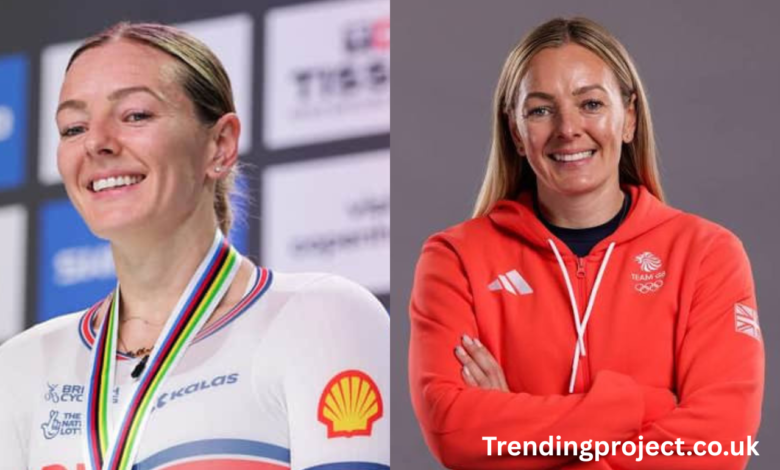
Few sporting careers take as many unexpected turns as Katy Marchant’s. She did not begin cycling as a young prodigy, and track cycling was not even her original sport. Marchant started out as a talented heptathlete and represented Great Britain at junior level before a routine power test on a Wattbike revealed that she possessed the explosive strength that could make her a natural track sprinter. At 19, she made the difficult decision to change sports. Only three years later, she stood on an Olympic podium at Rio 2016.
Her journey became even more remarkable in the years that followed. Marchant experienced Olympic disappointment, developed into one of Britain’s most experienced female track sprinters, became a mother, returned to elite competition and eventually won Olympic gold in Paris in 2024. Alongside Emma Finucane and Sophie Capewell, she helped Great Britain win its first Olympic women’s team sprint title, with the trio breaking the world record three times during the competition.
What makes Katy Marchant particularly fascinating is that her story does not end with Olympic success. After Paris, she suffered a serious crash, later became a mother for the second time and spent an extended period away from competitive racing. In 2026, she returned to major competition at the Glasgow Commonwealth Games, where she won silver in the women’s team sprint for England. Her latest comeback has also brought a new ambition: potentially competing at the Los Angeles 2028 Olympics for what could be her fourth and final Games.
Katy Marchant Facts at a Glance
| Fact | Details |
|---|---|
| Full name | Katy Louise Marchant |
| Date of birth | 30 January 1993 |
| Age | 33 years old in 2026 |
| Birthplace | Leeds, England |
| Nationality | British |
| Profession | Track cyclist and Olympic athlete |
| Main events | Sprint, team sprint, keirin and 500m time trial |
| Former sport | Heptathlon |
| Education | Brigshaw High School |
| Parents | Not reliably identified in major public sources |
| Siblings | She has a sister |
| Husband | Rob Nicholls |
| Children | Two sons, Arthur and Walter |
| Olympic medals | Gold and bronze |
| Olympic gold | Women’s team sprint, Paris 2024 |
| Olympic bronze | Individual sprint, Rio 2016 |
| World championship achievement | Women’s team sprint world champion, 2024 |
| European title | 500m time trial, 2024 |
| Commonwealth achievement | Team sprint silver, Glasgow 2026 |
| Honour | MBE, 2025 |
| @katymarchant | |
| X/Twitter | @katymarchant |
| Net worth | Not publicly verified |
| Other interests | Farming and bespoke cake making |
Early Life and Family Background
Katy Louise Marchant was born on 30 January 1993 in Leeds, England, and grew up in Yorkshire. Although cycling would eventually become the defining feature of her professional life, her first serious sporting ambitions came through athletics. She developed as a heptathlete, an event that requires competitors to combine sprinting, hurdling, jumping and throwing disciplines. That early experience gave Marchant a broad athletic foundation rather than the narrowly specialized background normally associated with elite track sprinters.
During her teenage years, Marchant trained at the English Institute of Sport in Sheffield and was coached by Toni Minichiello, the highly respected athletics coach associated with Olympic champion Jessica Ennis. Marchant represented Great Britain in the heptathlon at the 2012 World Junior Championships, demonstrating that she already had international potential before cycling entered the picture. Her time in athletics also taught her how to train consistently, compete under pressure and handle the demands of elite sport.
Her family has remained an important part of her life, although detailed information about her parents is not widely available through authoritative public biographies. Marchant has a sister, and later family life became closely connected with farming through her husband, Rob Nicholls. Away from professional cycling, she has participated in the work of the family farm and developed a separate passion for baking, even running a bespoke cake business. This combination of elite sport, family responsibilities and rural life gives her biography a particularly distinctive character.
The Unexpected Move From Heptathlon to Cycling
The biggest turning point in Marchant’s early life came when her athletic potential on a stationary bike attracted attention. During training, her Wattbike power figures were unusually impressive. Her athletics coach recognized that the strength and explosiveness she possessed might be better suited to track cycling, and Marchant was encouraged to investigate the possibility of changing sports. At first, the idea represented a huge gamble because she was already 19, an age when many elite cyclists have spent years developing their technical skills.
Marchant nevertheless embraced the challenge. She joined British Cycling’s Senior Academy in 2013 and began learning the technical side of track cycling from scratch. The transition required far more than simply becoming stronger or faster. She had to learn how to control a track bike at high speed, understand sprint tactics, read opponents and adapt to the highly technical environment of the velodrome. Her athletic background gave her the physical ingredients, but her rapid development demonstrated considerable discipline and adaptability.
The early results were striking. In 2013, Marchant already reached the podium at the British National Track Championships, winning silver in the team sprint and keirin and bronze in the individual sprint. In 2014, she won two bronze medals at the European Under-23 Track Championships, and by 2015 she had become European Under-23 champion in the keirin while also collecting four British national titles. What had begun as an experiment had quickly turned into a genuine elite sporting career.
Olympic Breakthrough at Rio 2016
Marchant’s extraordinary progress culminated at the 2016 Rio Olympics. Only three years after switching from athletics to cycling, she competed against the world’s best track sprinters in the women’s individual sprint. Rather than simply treating the Games as valuable experience, she produced a performance strong enough to earn an Olympic bronze medal. UK Sport records her bronze as part of Britain’s complete medal haul in track cycling at those Games.
The Rio medal immediately established Marchant as one of Britain’s most exciting young cycling talents. Her achievement was especially impressive because of how little time she had spent in the sport compared with many of her international rivals. The medal also validated the difficult decision she had made at 19: leaving an established path in athletics and committing herself to an unfamiliar discipline.
Rio also changed expectations. Marchant was no longer an experimental athlete learning a new sport; she was an Olympic medallist with the potential to build a long international career. The following years would see her explore different sprint disciplines, especially the keirin, while gaining experience that would eventually prove invaluable when Britain’s women’s sprint programme was rebuilt for another Olympic challenge. Her first Olympic medal was therefore not the conclusion of her breakthrough story but the beginning of a much longer chapter.
Developing as a World-Class Track Sprinter
After Rio, Marchant increasingly focused on the keirin, a tactical event in which riders race behind a motorized pace vehicle before launching into a high-speed sprint. She spent time at the renowned keirin training school in Izu, Japan, learning more about the tactics and technical demands of the event. That experience helped broaden her abilities beyond the traditional sprint and gave her another route to international success.
Her progress was rewarded in 2019 when she won her first UCI World Cup race in the keirin in Glasgow. The victory in front of a home crowd was an important milestone because it showed that her abilities extended beyond a single Olympic breakthrough. Marchant had become a versatile track cyclist capable of competing in several elite sprint disciplines.
The Tokyo Olympic cycle, however, proved much more difficult. At the delayed Tokyo 2020 Games, Marchant was the sole British female sprint representative. She reached the keirin quarter-finals but was involved in a crash that ended her medal hopes, while she finished fifth in the individual sprint. The disappointment became another important stage in her development because it forced her to reconsider what she wanted from the next phase of her career.
Motherhood and the Road Back to Elite Sport
One of the most significant chapters in Katy Marchant’s life began in 2022 when she became a mother for the first time. Her son Arthur was born in June that year. Rather than walking away from elite sport, Marchant began the difficult process of rebuilding her body and returning to competition. Team GB reported that she was back in the gym soon after giving birth and returned to the velodrome approximately six months later.
The physical challenge was only part of the equation. Marchant has spoken about the mental and logistical difficulty of returning to training while caring for a young child. Arranging childcare, dealing with the emotional pressure of leaving her son and managing the expectations of elite sport created challenges that could not be solved simply by increasing training hours. Her experience became part of a wider conversation about supporting mothers in high-performance sport.
Her return ultimately transformed her career. Rather than simply attempting to recover the form she had shown before pregnancy, Marchant became a crucial part of Britain’s rebuilt women’s team sprint programme. Her experience and power complemented the youth and speed of Emma Finucane and Sophie Capewell. The three riders began producing results that suggested Britain’s long wait for major women’s team sprint success might finally be coming to an end.
Olympic Gold at Paris 2024
The Paris 2024 Olympics became the defining sporting achievement of Katy Marchant’s career. She entered the Games as an experienced Olympic competitor and as a key part of Britain’s women’s sprint team. Alongside Emma Finucane and Sophie Capewell, she was part of a trio determined to change the story of British women’s sprint cycling after years without Olympic qualification in the event.
The result was historic. The British trio produced an extraordinary sequence of rides and broke the world record three times during the competition before defeating New Zealand in the final. They won gold in the women’s team sprint, giving Great Britain its first Olympic title in the event. For Marchant, the victory was particularly meaningful because it came after motherhood and a complete rebuilding of her career.
Marchant narrowly missed a second medal in Paris when she finished fourth in the keirin. Yet her Olympic campaign was already a remarkable success. Her role was also different from her earlier Games: in Rio she had been the young individual medal contender, while in Paris she was the experienced rider helping drive a team toward history. That evolution illustrates how dramatically her sporting identity had developed over eight years.
World Champion and European Champion in 2024
The success did not stop when Marchant left Paris. Later in 2024, she continued competing at the highest level and added more major titles to her record. At the European Track Championships, she became the first British woman to win the European 500m time-trial title. She also helped Britain take silver in the women’s team sprint, further confirming that the Paris result had not been a one-off performance.
At the UCI Track World Championships in Copenhagen, Marchant again joined Finucane and Capewell in the women’s team sprint. The British trio won world championship gold, completing an exceptional season in which they became both Olympic and world champions in the same year. It was another historic achievement for British women’s sprint cycling.
Marchant also collected individual medals at the world championships, taking bronze in both the 500m time trial and keirin. The combination of team and individual success made 2024 arguably the strongest season of her career. She had progressed from an athlete who had only recently discovered cycling into an Olympic and world champion with titles across multiple sprint disciplines.
Injury, Second Child and Another Comeback
Marchant’s post-Olympic period brought a severe setback. In December 2024, she suffered a serious crash during a keirin race at London’s Lee Valley VeloPark. The accident resulted in fractures to two bones in her right forearm and dislocated fingers, creating another major obstacle just months after the greatest achievement of her career. The injury required recovery and rehabilitation, leaving her away from competitive racing for an extended period.
While rebuilding her career, Marchant also became a mother for the second time. Her younger son Walter was born in 2025, meaning her return to elite competition involved recovering from a significant injury while adapting to life with two young children. This made her second comeback considerably different from her first return after the birth of Arthur.
The physical demands were particularly significant because track sprinting is built around explosive strength and peak power. Unlike endurance cyclists, elite sprinters depend heavily on short bursts, intense gym work and the ability to produce enormous force over very brief periods. Marchant has described regaining peak power as one of the most difficult aspects of returning after childbirth, making her latest comeback an unusual test within elite cycling.
Glasgow 2026 Commonwealth Games Comeback
In 2026, Marchant returned to a major multi-sport event at the Glasgow Commonwealth Games. It was her first Commonwealth Games appearance since 2018 and her first major event since the birth of her second child. Her selection for Team England demonstrated that British Cycling and the athlete herself believed she still had an important contribution to make at the highest level.
Marchant, Sophie Capewell and Rhianna Parris-Smith won silver in the women’s team sprint, finishing behind Wales. The result gave Marchant another major Games medal and provided tangible evidence that her second comeback was progressing successfully. She also competed in the individual sprint and advanced into the later stages of the competition.
The Glasgow performance was more than another medal. It showed that Marchant was still capable of competing with the world’s leading sprint cyclists after two pregnancies, serious injury and a long period away from racing. She has described her return as a challenge she genuinely enjoys, and her sights are now set beyond Glasgow. The possibility of a fourth Olympic appearance at Los Angeles 2028 remains an important motivation.
Husband, Children and Life Away From Cycling
Katy Marchant is married to Rob Nicholls, who works on the family farm. Their family life has become an important part of the practical reality behind Marchant’s sporting career. Elite cycling requires extensive travel and highly demanding training schedules, while farming has its own seasonal pressures. Balancing those responsibilities means that Marchant’s success depends not only on her individual commitment but also on a wider family support network.
The couple have two sons, Arthur and Walter. Marchant’s experience as a mother has become an important part of her public story, particularly because she has returned to elite sprint cycling after both pregnancies. Team GB highlighted her as one of the mothers who competed at Paris 2024, where Arthur was present to watch her win Olympic gold.
Away from the velodrome, Marchant also helps with the family farm and has a strong interest in baking. British Cycling identifies her bespoke cake business as one of her activities outside cycling. These interests reveal a side of her life that is very different from the highly controlled world of Olympic sport and help explain why Marchant’s identity extends beyond medals, records and competition.
Katy Marchant Net Worth and Sources of Income
Katy Marchant’s exact net worth has not been publicly disclosed by a reliable financial source. As a result, precise figures sometimes published on celebrity or biography websites should not be presented as confirmed facts. There is no authoritative public record establishing exactly how much she has earned during her professional cycling career, and her private sponsorship arrangements and investments are not fully known.
Her income can reasonably be understood as coming from several areas associated with an elite athlete. These may include sporting support, sponsorships, prize-related earnings, commercial opportunities and public appearances. Olympic success can significantly increase an athlete’s visibility, but it does not automatically translate into a publicly documented personal fortune. Marchant’s Olympic and world championship achievements have certainly strengthened her profile, but her exact financial position remains private.
Her other activities provide an additional dimension to her professional life. She has a bespoke cake business and contributes to the family farm, meaning her working identity is not restricted to cycling. Rather than focusing on an unsupported net-worth estimate, it is more accurate to view Marchant as an Olympic champion with multiple professional and family responsibilities whose exact personal wealth has not been publicly established.
Social Media and Public Image
Katy Marchant maintains a public presence on social media, where she has used the handle @katymarchant on platforms including Instagram and X/Twitter. Her social presence gives fans access to parts of her life beyond competition, including her experiences as an athlete, mother and member of a farming family. Team GB has also embedded posts from her Instagram account in its athlete coverage.
Her public image has evolved considerably since Rio 2016. Earlier in her career, she was primarily known as a promising Olympic sprint cyclist. Today, she is equally associated with resilience, motherhood and the ability to return to elite sport after major life changes. Her willingness to discuss the realities of training while raising children has helped make her story relatable to people who may never have experienced professional sport themselves.
Marchant’s online identity also reflects a grounded personality. Alongside Olympic achievements, her public story includes farming, baking and family life. That mixture makes her image different from the conventional presentation of an elite athlete. She can be simultaneously an Olympic champion, a mother, a farmer’s wife, a baker and a competitor still chasing another Olympic opportunity.
Awards, Honours and Major Achievements
Katy Marchant’s medal collection includes some of the most significant achievements available to a British track cyclist. Her Olympic bronze in the individual sprint at Rio 2016 established her as an elite athlete, while her Paris 2024 team sprint gold transformed her into an Olympic champion. She also became a world champion in the same discipline later that year.
Her 2024 season was particularly impressive because it included success at European, Olympic and world level. She won the European 500m time trial, Olympic team sprint gold and world championship team sprint gold, while also collecting world bronze medals in the 500m and keirin. The breadth of those results demonstrates her versatility as a sprint cyclist.
In 2025, Marchant received another important recognition when she was appointed an MBE. The honour added an official national distinction to a career that had already included Olympic medals, world titles and European success. Then, in 2026, she added another Commonwealth medal by winning women’s team sprint silver in Glasgow. Her career continues to expand rather than simply look back on past achievements.
Future Goals and the Road to Los Angeles 2028
At 33, Marchant is entering a very different stage of her sporting career. She has already achieved what many athletes spend their entire lives pursuing, but retirement is not currently the only option she is considering. Her performances in training and her return to international competition have reinforced her belief that she can continue competing at the highest level.
The biggest potential target is the Los Angeles 2028 Olympics. Marchant has spoken about wanting what she describes as another opportunity to experience the Olympic Games, potentially making Los Angeles her fourth Olympic appearance. Reaching that goal would require another two years of demanding training, careful recovery and the continued balancing of motherhood with elite sport.
Whether or not Los Angeles ultimately becomes the final chapter of her Olympic career, Marchant has already changed the shape of her own story several times. She moved from athletics to cycling, became an Olympic medallist, rebuilt her career after motherhood, became an Olympic champion, survived a serious crash, became a mother again and returned to the Commonwealth Games podium. Her next goal is therefore not about proving whether she belongs in elite sport; it is about discovering how far she can still take a career that has repeatedly exceeded expectations.
Conclusion: The Lasting Legacy of Katy Marchant
Katy Marchant’s story is ultimately about reinvention. She was not identified as a future Olympic cyclist during childhood, and she did not follow the conventional route into professional track cycling. Instead, a chance discovery of her extraordinary power output opened a new door at 19. She walked through it, accepted the enormous challenge of learning a new sport and reached the Olympic podium only three years later.
Her later achievements make the story even more powerful. Marchant did not allow Olympic disappointment, motherhood or serious injury to define the limits of her career. Her gold medal in Paris came after the birth of her first child, while her Commonwealth silver in Glasgow came after another pregnancy, another period away from competition and a serious arm injury. Each comeback required her to rebuild physically and mentally rather than simply return to where she had been before.
As Katy Marchant continues to pursue the possibility of another Olympic appearance in Los Angeles, her greatest legacy may extend beyond her medals. Her journey demonstrates that a career does not have to follow a straight line to become extraordinary. Talent can emerge unexpectedly, setbacks can become turning points, and personal responsibilities do not necessarily mean abandoning ambitious goals. From heptathlon to Olympic gold, from motherhood to another Commonwealth podium, Marchant’s story remains a powerful example of perseverance, adaptability and the courage to keep moving forward.