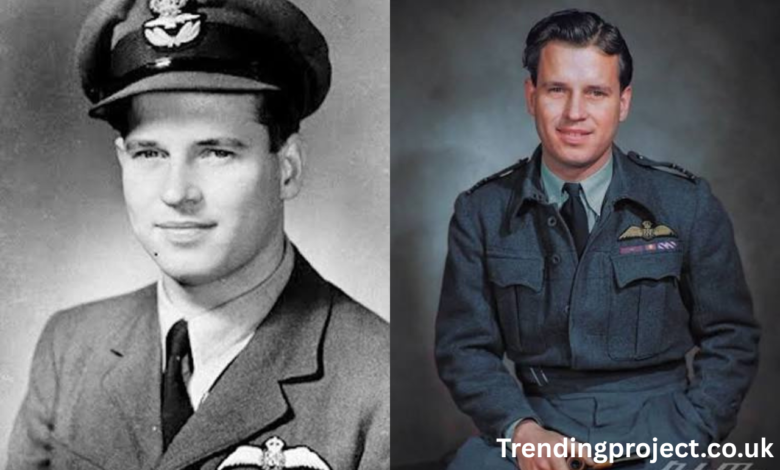
Few names from the Second World War are as closely associated with courage, daring and aerial warfare as Guy Gibson. At just 24 years old, the Royal Air Force officer was chosen to command the newly created No. 617 Squadron, a specialist unit assembled for one of the most technically demanding bombing missions of the war. On the night of 16–17 May 1943, Gibson led the famous Dambusters raid, flying heavily armed Lancaster bombers at extraordinarily low altitude to attack German dams using Barnes Wallis’s revolutionary bouncing bomb. The operation brought him the Victoria Cross and transformed him into an international wartime celebrity.
But the story of Guy Gibson is far richer than the famous raid alone. His life included an unsettled childhood, a fierce determination to become a pilot, years of dangerous operational flying, service as both a bomber pilot and night fighter, marriage, international recognition and, ultimately, a return to combat that ended with his death at only 26. He was courageous and exceptionally experienced for his age, but historical accounts also describe him as ambitious, demanding and sometimes difficult. That combination of extraordinary ability and human imperfection makes his biography particularly compelling.
Guy Gibson Quick Facts
| Category | Details |
|---|---|
| Full name | Guy Penrose Gibson |
| Born | 12 August 1918 |
| Birthplace | Simla, India |
| Died | 19 September 1944 |
| Age at death | 26 |
| Nationality | British |
| Profession | RAF officer, bomber pilot and night fighter pilot |
| Military branch | Royal Air Force |
| Final rank | Wing Commander |
| Father | Alexander James Gibson |
| Mother | Leonora Mary Gibson, née Strike |
| Siblings | Alexander (“Alick”) and Joan |
| Wife | Evelyn Mary “Eve” Gibson, née Moore |
| Children | None |
| Famous command | No. 617 Squadron RAF |
| Famous operation | Operation Chastise, the Dambusters raid |
| Victoria Cross | Awarded for his leadership during Operation Chastise |
| Other awards | DSO and Bar, DFC and Bar, U.S. Legion of Merit and campaign medals |
| Book | Enemy Coast Ahead |
| Operational record | More than 170 sorties |
| Social media | No personal Instagram, X/Twitter or LinkedIn accounts; he died in 1944 |
| Net worth | No reliable historical net-worth figure exists |
Early Life and Family Background
Guy Penrose Gibson was born on 12 August 1918 in Simla, India, into a British family connected to the colonial administration. His father, Alexander James Gibson, served in the Imperial Indian Forestry Service and became Chief Conservator of Forests for the Simla Hill States. His mother was Leonora Mary Gibson, née Strike. Guy had an elder brother, Alexander, known as Alick, and a sister, Joan. His earliest years in India were spent in surroundings very different from the Britain he would later know, and his childhood included the atmosphere of the British community living in the hill country.
When Gibson was six, his life changed dramatically. He moved to England with his mother, following the pattern of many children from British families living in India who were sent back to Britain for education. The transition from the warmer, familiar environment of India to boarding-school life in Britain was substantial. The RAF Museum’s historical research describes his childhood as unusually unsettled, with family separation and emotional difficulties forming part of his upbringing. His parents increasingly went their separate ways, while Guy and his siblings depended significantly on relatives and one another.
Gibson’s difficult family circumstances have sometimes been considered when historians examine the qualities he later displayed as a military commander. He developed a strong degree of independence and an intense determination to prove himself. His mother, Leonora, experienced serious personal difficulties, including problems associated with alcohol, and died in December 1939. Gibson’s early life therefore contained considerably more uncertainty than the polished image of the later wartime hero might suggest.
Education and Early Ambition to Fly
Gibson attended St George’s Preparatory School in Folkestone before moving to St Edward’s School in Oxford. His education did not immediately suggest that he was destined to become one of Britain’s best-known military aviators. Historical accounts describe him as someone who worked hard but was not regarded as an exceptional academic. Nevertheless, he developed a powerful interest in aviation, and flying gradually became one of the defining ambitions of his young life.
At St Edward’s, Gibson was in the same school environment as Douglas Bader, another future RAF legend. Gibson admired famous pilots and developed an intense fascination with the possibilities of aviation. His initial ambition was reportedly to become a civilian test pilot, an aspiration that says something about his attraction to risk, technical skill and high-performance flying even before the outbreak of war.
His route into the RAF was not entirely straightforward. He was initially rejected on medical grounds because of his height and physical measurements, but he persisted and was eventually accepted. On 16 November 1936, at only 18, Gibson joined the Royal Air Force on a short-service commission. His determination to overcome that initial rejection was an early indication of the persistence that would become a defining feature of his military career.
Joining the Royal Air Force
Gibson began his flying training at Yatesbury in Wiltshire and continued through RAF training establishments before being posted to No. 83 Squadron. He qualified as a pilot in 1937 and began flying Handley Page Hampdens. By the time Britain entered the Second World War in September 1939, he was already an operational RAF officer with experience in military aviation.
The beginning of the war placed Gibson in an environment where experience accumulated rapidly and survival could depend on skill, discipline and luck. His squadron initially undertook operations including minelaying and attacks connected with German naval activity. Gibson subsequently participated in numerous bombing missions across occupied Europe. By the summer of 1940, he had developed a reputation as a determined operational pilot and was awarded the Distinguished Flying Cross for gallantry and devotion to duty.
His operational appetite was remarkable even at this early stage. Rather than treating combat as something to endure until a safer assignment arrived, Gibson repeatedly sought opportunities to continue flying. The official Victoria Cross citation later highlighted his willingness to participate in dangerous operations and his tendency to extend his operational career rather than retreat from combat.
From Bomber Pilot to Night Fighter
One of the most interesting aspects of Guy Gibson’s RAF career is that he was not simply a bomber pilot. After his initial bomber tour, he transferred to Fighter Command and became a night fighter pilot with No. 29 Squadron. He flew Bristol Beaufighters and became involved in the developing techniques used to intercept German bombers attacking Britain at night.
Night fighting presented an entirely different challenge from conventional daylight bombing. Pilots had to locate enemy aircraft in darkness, work with evolving radar technology and operate under conditions where visual identification could be extremely difficult. Gibson eventually achieved several confirmed victories, with English Heritage recording that he shot down four German bombers. His performance earned him promotion to squadron leader and a Bar to his Distinguished Flying Cross.
The experience proved important for his later leadership. Gibson gained an understanding of different aspects of aerial warfare and became familiar with the technical and tactical problems faced by aircrew operating under extreme pressure. His willingness to move between roles also reinforced his reputation as an officer who wanted to remain close to operational flying rather than settle comfortably into a purely administrative career.
Command of No. 106 Squadron
In April 1942, Gibson returned to Bomber Command and took command of No. 106 Squadron. The squadron was transitioning to the powerful Avro Lancaster, and Gibson was responsible for helping turn the new aircraft and its crews into an effective operational force. His missions during this period included attacks against targets in Germany, France and Italy.
His operational record continued to grow at an extraordinary rate. He flew against targets including Cologne, Danzig, Genoa, Le Creusot, Milan, Nuremberg and Stuttgart. His performance brought him the Distinguished Service Order, followed by a Bar, adding to the DFC and Bar he had already received. By early 1943, he was a remarkably experienced combat pilot despite being only 24 years old.
This combination of experience, aggression and leadership made Gibson an obvious candidate for an extraordinary new assignment. The RAF needed an officer capable of forming and commanding a completely new squadron for a mission that required precision flying, experimental weapons and extraordinary discipline. That assignment would change his place in military history forever.
Formation of the Dambusters Squadron
In March 1943, Gibson was transferred to help establish No. 617 Squadron at RAF Scampton in Lincolnshire. The squadron was created specifically for special operations, and its first major assignment was the attack on German dams in the Ruhr region. The mission demanded a combination of technical innovation, extremely accurate navigation, low-level flying and precise weapons deployment.
The weapon at the centre of the mission was the famous “Upkeep” bouncing bomb developed by engineer Barnes Wallis. The bomb had to be released from a very low altitude—approximately 60 feet or 18 metres—and at a carefully controlled speed and distance from the dam. Training therefore involved extraordinarily dangerous low-level flying. Gibson and his crews had only a matter of weeks to prepare for the mission.
Gibson’s leadership style during the preparation of No. 617 Squadron was demanding and intensely practical. He had to coordinate aircraft, crews, maintenance, navigation, training and operational planning while dealing with a tight deadline. The RAF Benevolent Fund describes how Gibson approached the immense organisational challenge by making lists of everything that needed to be done and systematically working through them.
The Dambusters Raid and Operation Chastise
On the night of 16–17 May 1943, nineteen Lancaster bombers of No. 617 Squadron took part in Operation Chastise. Gibson led the formation, with the Möhne, Eder and Sorpe among the principal targets. The aircraft had to fly at extremely low altitude, navigating through darkness while avoiding obstacles and enemy defences. The operation was among the most audacious bombing missions attempted by the RAF during the war.
Gibson personally led the first attack against the Möhne Dam. After releasing his weapon, he remained in the area at very low altitude, deliberately drawing enemy fire toward his aircraft and away from the Lancaster making the next attack. The official Victoria Cross citation specifically praised this action, noting that Gibson continued circling at low level for around 30 minutes to make the following crews’ approaches as safe as possible.
The Möhne and Eder dams were breached, while the Sorpe was damaged less severely. The price was enormous: eight Lancaster aircraft were lost and 53 of the 133 aircrew involved were killed. The RAF Museum records that approximately 40 percent of the participating aircrew died. The raid produced significant physical damage and temporary disruption, but its strategic effects were mixed and German industrial capacity recovered relatively quickly. Its psychological and propaganda impact, however, was immense.
Victoria Cross and International Fame
Gibson’s conduct during Operation Chastise resulted in the award of the Victoria Cross, the highest British military decoration for valour in the face of the enemy. His citation praised not only his actions during the dam attack but also his exceptional operational record and his repeated willingness to return to combat. By then he had completed more than 170 sorties and more than 600 hours of operational flying.
The Victoria Cross made Gibson one of Britain’s most famous servicemen. His investiture took place on 22 June 1943, when he received the decoration from Queen Elizabeth, later known as the Queen Mother. His medal bar, including the Victoria Cross, is now held by the RAF Museum, alongside other important material connected with his wartime career.
His fame quickly extended beyond Britain. Gibson travelled to Canada and the United States as part of the British wartime effort and accompanied Winston Churchill’s entourage during the Quebec Conference period. In October 1943 he was presented with the American Legion of Merit. The young RAF commander had become not merely a decorated officer but an international symbol of British air power.
Guy Gibson’s Wife and Personal Life
Gibson married Evelyn Mary “Eve” Moore on 23 November 1940 at All Saints’ Church in Penarth, Glamorgan. Eve was a dancer, and the couple remained married until Gibson’s death. They had no children. Their marriage unfolded against the extraordinary pressures of wartime Britain, when RAF officers could spend long periods away from home and face the possibility of death on every operation.
During periods of leave, Gibson and Eve lived at 32 Aberdeen Place in St John’s Wood, London. English Heritage records that the house later received a blue plaque commemorating Gibson, and it was also the place where he worked on his wartime memoir. The address consequently became an important physical connection between Gibson’s private life and the historical record he left behind.
Gibson’s personality remains a subject of considerable historical discussion. Some accounts portray him as hardworking, efficient, straightforward and sociable, while others emphasise his arrogance, impatience or difficult treatment of some junior personnel and ground crews. The RAF Benevolent Fund similarly notes that he could communicate effectively with fellow officers while sometimes creating friction with non-commissioned officers and ground staff.
Enemy Coast Ahead and His Written Legacy
One of Gibson’s most valuable contributions to the historical record came through his book Enemy Coast Ahead. Written during the war and published posthumously in 1946, the memoir provided a first-hand account of his experiences as an RAF officer and operational pilot. It allowed readers to encounter his own perspective rather than relying entirely on later biographies and official histories.
The memoir is especially valuable because Gibson wrote much of it while staying at his London home. It captures his experiences across different stages of the war and provides insight into the mindset of an operational airman. The work also preserves Gibson’s distinctive personality, including his directness and his strong opinions about military service and flying.
Its influence continued long after his death. The RAF Museum notes that Enemy Coast Ahead remained popular and had been reprinted many times by the time the 1955 film The Dam Busters appeared. The book became an important part of the cultural legacy surrounding Gibson and Operation Chastise.
Final Mission and Death
After the Dambusters raid, Gibson’s fame created a difficult situation. He was now so well known that sending him repeatedly into combat carried obvious risks, and he spent periods on publicity, staff and training duties. Yet he remained deeply dissatisfied with being removed from operational flying. His instinct was still to return to the aircraft and the missions he understood best.
In 1944, Gibson successfully sought permission to return to operations. On the night of 19 September 1944, he flew as a Master Bomber during an attack involving targets around Rheydt and Mönchengladbach. He was flying a de Havilland Mosquito borrowed from No. 627 Squadron, accompanied by navigator Squadron Leader James Warwick.
Gibson never returned from that mission. His Mosquito crashed in the Netherlands during the return journey, killing both men. He was only 26. The exact circumstances of the crash have remained uncertain, but Gibson and Warwick were eventually buried at Steenbergen-en-Kruisland in the Netherlands. His death brought an abrupt end to a military career that had already become legendary.
Guy Gibson Net Worth and Income
It is important to approach the subject of Guy Gibson’s net worth differently from the finances of a modern celebrity. Gibson was an RAF officer who lived during wartime Britain, not a commercial personality earning money through sponsorships, social-media deals or entertainment contracts. His principal income came from his military service, and there is no credible historical documentation establishing a modern-style net worth for him.
Online estimates that assign Gibson a specific fortune should therefore be treated with considerable skepticism. There is no reliable evidence supporting a precise figure, and converting his wartime salary and possessions into a present-day celebrity net-worth number would create a misleading impression. His historical importance was never connected to financial wealth.
Gibson’s enduring “value” is instead cultural and historical. His Victoria Cross, military medals, logbook, manuscript material and other objects connected with his career have become significant historical artefacts. The RAF Museum holds his Victoria Cross, DFC and DSO medals, his 617 Squadron logbook and the original draft of Enemy Coast Ahead.
Social Media Presence and Modern Legacy
Guy Gibson has no personal Instagram, Facebook, X/Twitter or LinkedIn account because he died in 1944, decades before the internet and social-media platforms existed. Any modern profile using his name should therefore be regarded as a historical, commemorative or fan-created account unless it is clearly operated by an established institution.
His story nevertheless has a substantial digital presence today. Museums, historians, aviation organisations and historical websites continue to publish photographs, documents, biographies and research concerning Gibson and No. 617 Squadron. His name remains strongly connected with the Dambusters, the Lancaster bomber and the wider history of RAF Bomber Command.
His physical legacy is equally extensive. English Heritage placed a blue plaque at 32 Aberdeen Place in London, while the RAF Museum preserves important personal and military objects associated with him. Memorials and commemorations exist in Britain and the Netherlands, demonstrating how his story has continued to cross national and generational boundaries.
Guy Gibson’s Legacy
The legacy of Guy Gibson cannot be separated from Operation Chastise. His name became almost synonymous with the Dambusters, and his leadership during the raid has been studied for decades as an example of command under extraordinary pressure. One of the most striking aspects of his leadership was his willingness to expose his own aircraft to enemy fire so that other crews could make their attacks.
At the same time, Gibson’s story is more valuable when it is viewed honestly rather than turned into a flawless hero narrative. He was brave, skilled and intensely committed to flying, but he could also be abrasive and self-important. The RAF Benevolent Fund and other historical accounts make clear that he was not universally popular, even among the men he commanded. Those contradictions do not erase his achievements; instead, they help explain the complicated human being behind the legend.
Perhaps the most powerful part of Gibson’s legacy is the extraordinary amount he accomplished before reaching his 27th birthday. From an uncertain childhood and an initially unsuccessful attempt to enter the RAF, he became a decorated bomber pilot, night fighter, squadron commander, Victoria Cross recipient and international wartime figure. His life was tragically brief, but the determination that carried him through rejection, danger and responsibility ensured that his name would remain part of aviation history.
Conclusion
Guy Gibson’s biography is ultimately a story of ambition, courage, leadership and sacrifice. Born in Simla in 1918, educated in Britain and drawn to aviation from an early age, he built a remarkable RAF career through persistence and an extraordinary willingness to accept danger. His service as a bomber pilot and night fighter prepared him for the role that would define his name: commanding No. 617 Squadron during Operation Chastise.
The Dambusters raid made Gibson famous, but it was only one chapter of a life already filled with dangerous operations and remarkable achievements. His Victoria Cross recognised a pattern of leadership and personal courage that extended across his wartime career. His subsequent international fame, memoir Enemy Coast Ahead and continued commemoration ensured that his story survived far beyond the war.
Guy Gibson died at 26, long before he could discover what a post-war life might have looked like. Yet his story continues to raise important questions about courage, leadership and the price of heroism. He was neither an ordinary pilot nor a perfect hero; he was a determined and complicated young man who placed himself repeatedly in extraordinary situations. As Guy Gibson’s legacy continues to be remembered, his life stands as a reminder that perseverance can overcome setbacks, that leadership is often demonstrated through action, and that even a short life can leave an extraordinarily lasting mark on history.