Allison Curbishley Biography: The Olympic 400m Runner Who Built a Second Career in Sports

Allison Curbishley’s story begins on the athletics track, but it certainly does not end there. Born on June 3, 1976, she developed into one of Britain’s notable 400-metre runners of the 1990s, competed at two Olympic Games, won Commonwealth Games silver for Scotland, became a European Championships medallist and established a personal best of 50.71 seconds. Yet the most remarkable part of her journey may have come after elite competition. Repeated knee injuries eventually forced her away from competitive athletics, but instead of disappearing from the sporting world, Curbishley transformed her experience as an athlete into a career in broadcasting, event management and sports development.
Table of Contents
ToggleHer career offers an unusually complete picture of life in elite sport. She experienced the excitement of Olympic selection, the satisfaction of winning medals, the disappointment of injury and the uncertainty of retirement. Later, she became a familiar athletics voice through BBC Radio 5 Live, worked on major sporting events and became involved in organising running races and community-focused initiatives. In 2026, she remains active in athletics through broadcasting and event work, proving that retirement from competition does not necessarily mean retirement from the sport itself.
Allison Curbishley Quick Facts
| Category | Details |
|---|---|
| Full Name | Allison Curbishley |
| Date of Birth | June 3, 1976 |
| Age | 50 years old in 2026 |
| Birthplace | Newcastle upon Tyne, England, according to Olympedia |
| Nationality | British |
| Sporting Representation | Great Britain and Scotland |
| Main Event | 400 metres |
| Personal Best | 50.71 seconds |
| Olympic Games | Atlanta 1996, Sydney 2000 |
| Commonwealth Achievement | 400m silver, Kuala Lumpur 1998 |
| European Achievement | 4×400m relay bronze, 1998 |
| European U23 Achievement | 400m champion, 1997 |
| World Student Games | 400m champion, 1997 |
| Education | University of Birmingham, Sport and Exercise Sciences |
| Profession | Former elite athlete, broadcaster, event professional |
| Partner | Steve Cram |
| Broadcasting | BBC Radio 5 Live athletics commentator |
| Business | Extra Mile Media and Events; DS Media and Events |
| Net Worth | No reliable publicly verified figure |
| No personal account confidently verified | |
| X/Twitter | @ExtraMileme associated with Extra Mile Media |
| No personal account confidently verified |
Early Life and the Beginnings of Her Sporting Ambition
Allison Curbishley was born on June 3, 1976, with Olympedia identifying Newcastle upon Tyne, England, as her birthplace. Some secondary biographies have associated her with Stockton-on-Tees, which is why different online profiles occasionally give different descriptions of her hometown. The reliable sporting record, however, is clear about her date of birth and her later development as an elite British athlete.
Her interest in sport began surprisingly early. According to biographical information reproduced by sporting sources, she became involved in a summer holiday play scheme when she was about ten years old, and the experience helped spark her interest in athletics. Running eventually became her main sporting pursuit, but she was by no means a single-sport child. She also reached county standard in netball and field hockey, showing that competitive sport was a broader part of her development.
That early exposure to different sports likely helped shape the competitive qualities that later became visible on the athletics track. Curbishley grew into an athlete capable of handling both individual and relay competition, while her later career would demonstrate an equally broad understanding of sport away from competition. Her journey therefore began not with instant international fame, but with ordinary opportunities to participate, compete and discover what she was capable of achieving.
Education and Development as an Athlete
Curbishley eventually studied Sport and Exercise Sciences at the University of Birmingham, an academic choice that closely complemented her sporting ambitions. Studying sport at university while pursuing high-level athletics would have exposed her to areas such as physical conditioning, human performance and the scientific principles behind training. Her education later provided a useful foundation for a career that remained firmly connected with sport even after she stopped competing.
Her junior career showed that she was developing into a versatile quarter-miler. The Edinburgh Athletic Club record lists appearances at the 1993 European Junior Championships and the 1994 World Junior Championships, where she competed in the 400m hurdles and 4×400m relay. She also competed in the World Student Games, demonstrating that her progression was already extending beyond domestic competition.
During these formative years, Curbishley built the technical and competitive foundation that would later allow her to specialise in the flat 400 metres. The event demands a difficult balance between speed and endurance, requiring athletes to maintain near-sprint intensity over an entire lap. Curbishley eventually became one of Britain’s leading specialists in precisely that discipline, but her early involvement in hurdles and relay events shows how varied her route to the top actually was.
The Breakthrough Year of 1997
The year 1997 represented a major turning point for Allison Curbishley. Olympedia records that she broke the 51-second barrier in the 400 metres for the first time that year, an important milestone in her development as an international athlete. She also won both the European Under-23 title and the World Student Games title, immediately establishing herself as a serious contender on the international athletics circuit.
Her European Under-23 victory was particularly significant because it demonstrated her ability to perform under championship pressure. She won the 400m in 50.85 seconds and also contributed to the British 4×400m relay victory. At the World Student Games in Catania, she again won the individual 400m, recording 50.84 seconds. These performances showed that her improvement was not the result of one isolated race but part of a sustained upward trajectory.
The same year also brought her onto the senior world stage. Curbishley represented Great Britain at the World Championships in Athens and helped the British 4×400m relay team finish sixth. The experience was important preparation for the even greater challenges that would follow. By the end of 1997, she had moved from promising young athlete to established international 400m runner.
Commonwealth Games Success in 1998
If 1997 announced Allison Curbishley’s arrival, 1998 established her as one of the leading athletes in her event. She won the British 400m championship and continued to lower her times. Her performances that season culminated in one of the defining moments of her career at the Commonwealth Games in Kuala Lumpur.
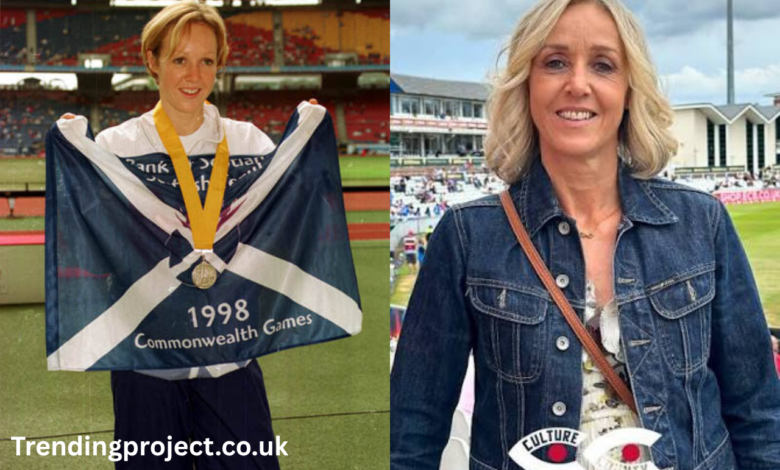
Representing Scotland, Curbishley won silver in the women’s 400 metres. She recorded 50.71 seconds, which remains her recognised personal best according to World Athletics. That performance also became a landmark in Scottish athletics, with Scottish Athletics continuing to refer to Curbishley as the Scottish 400m record holder.
The Commonwealth medal was especially meaningful because Curbishley represented Scotland through her maternal connection. Olympedia describes the medal as coming while representing her mother’s homeland. Her performance gave Scotland its only athletics medal at those 1998 Commonwealth Games and became an important part of her sporting legacy.
European Championships and Her Personal Best
The 1998 season was not limited to Commonwealth success. Curbishley also reached the 400m final at the European Championships and helped Great Britain win bronze in the women’s 4×400m relay. World Athletics officially lists her as a European Championships bronze medallist and records her 400m personal best at 50.71 seconds, achieved on September 18, 1998.
Her performances that season demonstrated remarkable consistency. She could compete successfully in individual races while also contributing to relay teams, a demanding role that requires athletes to perform under different tactical and physical circumstances. The 4×400m relay also placed additional importance on teamwork, baton exchanges and the ability to respond to the pressure created by other nations.
Curbishley’s 50.71-second performance remains one of the clearest statistical markers of her career. More than two decades later, the time continues to appear prominently in official athletics databases. It captures the level she reached during the peak period of her competitive career and explains why her name remains familiar to followers of British and Scottish athletics.
Allison Curbishley at the Olympic Games
Curbishley reached the Olympic stage for the first time at Atlanta 1996, where she was selected as part of Britain’s women’s 4×400m relay team. Although her major individual breakthrough came later, Olympic selection itself represented an enormous achievement for a young athlete. Team GB records her Atlanta appearance as part of the relay squad.
Four years later, she returned to the Olympics in Sydney with substantially greater individual credentials. At the 2000 Games, she competed in both the women’s 400 metres and the 4×400m relay. Olympedia records her as reaching the quarter-final stage in the individual 400m and sixth place with the British relay team.
Her two Olympic appearances provide an important perspective on the length and quality of her career. Atlanta came before her breakthrough season, while Sydney came after Commonwealth and European success and amid increasingly serious injury problems. The fact that she managed to return to Olympic competition despite those difficulties is one of the quieter achievements of her career.
Injury, Six Knee Operations and Retirement
The greatest obstacle in Curbishley’s athletic career was not a lack of ability but persistent knee problems. Her knees required surgery repeatedly, with sporting records stating that she underwent six operations during her career. These injuries severely affected her ability to build on the performances that had made her one of Britain’s strongest 400m runners.
After Sydney, she attempted to find another route back into competition by experimenting with the 800 metres and 400m hurdles. The efforts illustrate how reluctant she was to simply accept that her elite career was finished. Unfortunately, the physical problems continued, and the sixth knee operation proved unsuccessful in restoring her ability to compete at the required level.
Curbishley eventually retired from competitive athletics in 2003. Her retirement marked the end of a sporting career that had stretched from the early 1990s through two Olympic cycles, but it did not mark the end of her relationship with athletics. In fact, the years following retirement would reveal another side of her professional abilities.
Transition From Athlete to Sports Broadcaster
One of Curbishley’s most successful post-athletics decisions was to move into broadcasting. Since 2003, she has been associated with BBC Five Live’s athletics coverage, working as a commentator and summariser on international competitions. Her role allows her to combine professional broadcasting skills with first-hand knowledge of elite competition.
Her broadcasting portfolio has included Olympic Games, Paralympic Games, World Championships, European Championships and Commonwealth Games. That range means she has experienced major athletics events from both sides: first as an athlete walking into championship stadiums, and later as a broadcaster explaining those same competitions to listeners.
That dual perspective is one of Curbishley’s greatest professional strengths. She understands what it means for an athlete to prepare for a major race, cope with expectations, deal with injury and execute a strategy under pressure. As a broadcaster, she can use that experience to add context that statistics and results alone cannot provide.
Event Presenting and Media Work
Curbishley’s work has not been restricted to commentary. Since 2010, she has also worked with England Netball’s international series as an event MC, appearing at events in Manchester, Liverpool, Birmingham, Nottingham and London. This part of her career highlights her versatility as a communicator and presenter.
The role of an event MC requires a very different skill set from running a 400m race. It involves maintaining audience engagement, understanding the rhythm of live events, interviewing personalities and adapting quickly when circumstances change. Curbishley’s transition into this work demonstrates how the confidence developed through elite sport can translate into public-facing professional roles.
Her experience as a former Olympian also gives her credibility when speaking to audiences about sporting performance. Rather than discussing athletics purely from a theoretical perspective, she can draw upon years of international competition. That mixture of sporting knowledge and communication ability has become central to her second career.
Business Partnership With Steve Cram
Another important part of Curbishley’s post-athletics life has been her professional and personal relationship with former world champion and Olympic medallist Steve Cram. Olympedia states that Curbishley was coached by Cram and that their relationship began in 2002. The two have subsequently worked together in sports media and events.
Together, they have been associated with Extra Mile Media and Events, a business involved in sporting and corporate events. Their work has included charity golf days, corporate dinners, conferences and other event-related activities. The partnership allowed Curbishley to continue using her sporting network while developing a business career outside traditional athletics competition.
She has also been associated with DS Media and Events, which has organised running events including the Kielder Marathon and Sunderland City races. This part of her career is especially significant because it brings her back to the core activity that shaped her own life: running, but now through the organisation and delivery of events for thousands of other participants.
Community Sport and Inspiring New Generations
Curbishley’s influence has also extended into community sport. Following her retirement, she became involved in the development of Sporting Ambassadors, an initiative that evolved into Sporting Champions. The programme connected sporting professionals with schools and community groups, using athletes as positive role models and encouraging young people to become involved in sport.
This work adds another dimension to her legacy. Elite sport can sometimes appear distant to children who have never encountered high-level athletes personally. Bringing sporting figures into schools and community environments can make achievement feel more attainable. Curbishley’s own journey—from discovering athletics as a child to reaching two Olympics—gives her an authentic story to share with young people.
Her philosophy on sport has also become increasingly focused on inspiration and accessibility. In a Scottish Athletics interview, she reflected on the importance of athletes becoming visible role models for the next generation and described how seeing successful Scottish athletes can help young people believe that high-level achievement is possible for them too.
Allison Curbishley and the 2026 Running Scene
Curbishley’s professional involvement in running remains active in 2026. Events of the North, the organisation associated with Curbishley and Steve Cram, took responsibility for organising the Middlesbrough 10K and Ali Brownlee 5K as part of the new Middlesbrough Runs weekend. The 2026 event programme also included Paula Radcliffe’s Families on Track initiative.
The Middlesbrough project reflects how dramatically Curbishley’s role in athletics has evolved. In her competitive years, the focus was on personal performance measured in hundredths of a second. In event management, success is measured differently: participation, organisation, atmosphere, community involvement and the ability to make running accessible to people of different ages and abilities.
Her continued work also shows that her career is not simply a nostalgic connection to the athletics of the 1990s. She remains part of the contemporary sporting environment. Her experience as an Olympian and broadcaster gives her a valuable perspective, while her work in event delivery connects her directly with the current generation of recreational and competitive runners.
Allison Curbishley’s Broadcasting Role in 2026
Curbishley’s broadcasting career remains relevant to major athletics competitions. BBC coverage plans for the 2026 European Athletics Championships in Birmingham identified her as part of BBC Radio 5 Live and BBC Sounds coverage alongside other established athletics commentators and experts. The championships were scheduled for August 10–16, 2026.
Her continued presence in major-event coverage is a testament to the longevity of her second career. She began broadcasting after retiring from competition in 2003, meaning her experience now spans more than two decades. Few former athletes manage to remain connected to their sport for that long while successfully changing professional roles.
In July 2026, she also appeared on Paula’s Run Club in a Commonwealth Games-focused episode from Glasgow. The appearance showed that her knowledge continues to be valued not only by traditional broadcasters but also by modern running media and podcast audiences.
Personal Life, Family and Relationship With Steve Cram
Curbishley has generally kept much of her private family life away from the public spotlight. Reliable sporting biographies provide considerable information about her athletics career but relatively little verified detail about her parents, siblings or wider family background. For that reason, claims circulating on low-quality biography websites should be treated cautiously rather than presented as established fact.
Her relationship with Steve Cram is much better documented. According to Olympedia, Curbishley was coached by Cram and the two began a relationship in 2002. Their personal relationship developed alongside a professional partnership that has continued through media, event management and business activities.
The combination of personal and professional collaboration is unusual, particularly within elite sport. Both understand the demands and pressures of athletics, and both have built careers that extend beyond their competitive achievements. Their shared involvement in sporting events has allowed them to remain influential in British running while developing new projects outside the traditional athletics system.
Allison Curbishley Net Worth and Income Sources
There is no dependable public record establishing Allison Curbishley’s exact net worth. Online celebrity and biography websites sometimes publish numerical estimates, but those figures generally do not provide audited accounts or sufficient evidence to establish what she personally owns or earns. A responsible biography should therefore avoid presenting an unsupported dollar amount as fact.
Her documented professional activities suggest several potential income streams. These include broadcasting and commentary, event presenting, corporate hosting, sports-event management, media production and business directorships. Her work with Extra Mile Media and Events and DS Media and Events provides an important business component to her career beyond athletics.
Her financial story is therefore best understood as one of long-term professional diversification. Instead of relying solely on earnings from her competitive athletic career, she developed several complementary roles. Broadcasting gave her a media career, event management created a business pathway, and community sport allowed her to remain connected with participation and development.
Social Media and Public Presence
Curbishley’s public presence online is primarily professional rather than celebrity-driven. Her social media activity is closely connected to athletics, running events, broadcasting and the businesses associated with her sporting work. The X/Twitter account @ExtraMileme has been publicly associated with Extra Mile Media and Events and provides a professional link to her event-related activities.
Unlike many contemporary public figures, Curbishley does not appear to have built her reputation around constant personal social-media exposure. Her public identity remains centred on her work, sporting expertise and involvement in major events. This is consistent with the broader character of her career, where credibility has generally come from experience and professional achievement rather than celebrity culture.
There are online profiles using her name on platforms such as Instagram and LinkedIn, but without sufficiently strong verification it would be misleading to identify specific accounts as her official personal profiles. The most reliable approach is therefore to distinguish confirmed professional associations from unverified social-media pages.
Allison Curbishley’s Lasting Legacy
Curbishley’s athletic legacy is anchored by several achievements that remain significant more than two decades after her retirement. She was a European Under-23 champion, World Student Games champion, British champion, European Championships bronze medallist, Commonwealth Games silver medallist and two-time Olympian. Her 50.71-second 400m personal best remains officially recorded by World Athletics.
Yet her legacy extends beyond medals and times. Her willingness to move into broadcasting after injury ended her competitive career demonstrates an ability to redefine herself without abandoning the world that shaped her. Through BBC commentary, event management and community initiatives, she has continued contributing to athletics from different positions.
Perhaps the most meaningful aspect of her story is the way she now helps tell the stories of other athletes. As a former competitor, she knows the sacrifice behind the result. As a commentator, she can explain that sacrifice to audiences. And as an event professional, she helps create opportunities for people who may be taking their very first steps into running.
Conclusion: A Career Built on Resilience and Reinvention
Allison Curbishley’s journey is much larger than the statistics attached to her athletics career. The 50.71-second personal best, Commonwealth silver medal, European bronze and Olympic appearances tell us how successful she was as an athlete, but they do not fully explain why her story continues to resonate. Her real achievement lies in what she did when the circumstances changed.
Six knee operations and a difficult retirement could easily have brought an end to her connection with elite sport. Instead, Curbishley created a second career through broadcasting, event management, media and community sport. Her work in 2026 demonstrates that she remains an active part of the athletics world, decades after she first competed internationally.
Her life offers a valuable lesson about resilience: sometimes perseverance does not mean continuing along exactly the same path. Sometimes it means recognising when one chapter has ended and using everything learned from it to create another. Allison Curbishley did that with remarkable success. From an ambitious young runner to an Olympian, from an injured athlete to a respected broadcaster and from competitor to event organiser, her career illustrates how passion can evolve without disappearing. As she continues to contribute to running, broadcasting and community sport, her story remains a powerful reminder that a meaningful legacy is built not only by winning races, but also by helping others believe they can run their own race.