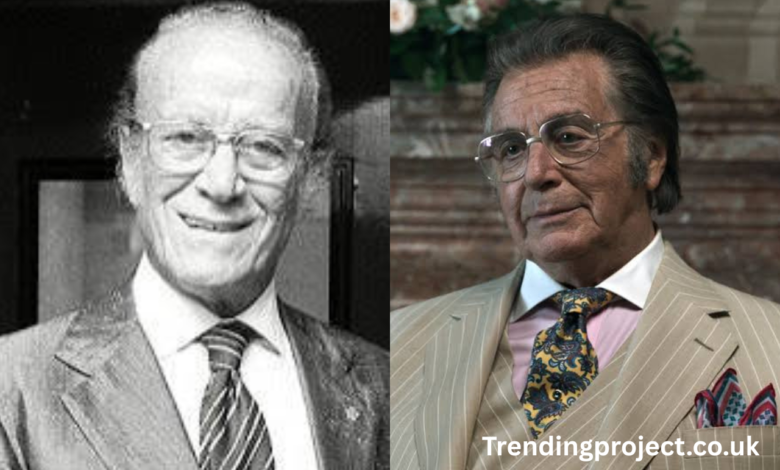
Aldo Gucci’s name is inseparable from one of the most recognizable luxury brands in modern fashion. Long before Gucci became a global empire of handbags, shoes, clothing, fragrances and iconic monograms, it was a family business rooted in Florence and built around leather craftsmanship. Aldo, the eldest son of founder Guccio Gucci, played a crucial role in taking that Florentine enterprise beyond Italy and turning it into an international symbol of sophistication, Italian craftsmanship and luxury. His story, however, was never simply one of success. It was also shaped by family rivalries, corporate power struggles, personal controversy and the difficult consequences of building a business where family and ownership were deeply intertwined.
Aldo Gucci was born in Florence on May 26, 1905, and spent much of his life inside the business his father established. He understood early that Gucci’s future depended on more than producing beautiful leather goods. The company needed prestigious stores, international customers, memorable branding and a strong connection between its products and the lifestyle its customers desired. His commercial instincts helped Gucci move from a respected Italian leather-goods company toward the international fashion house that audiences recognize today.
What makes Aldo Gucci particularly fascinating is the contrast between his extraordinary achievements and the turbulent final chapter of his career. He helped establish Gucci in the United States and strengthen its international identity, yet he eventually lost control of the company amid a bitter family dispute. He also faced a major U.S. tax-evasion case that resulted in a prison sentence. Looking at both sides of his life provides a much more complete understanding of the businessman behind the famous Gucci name.
Aldo Gucci Quick Facts
| Fact | Details |
|---|---|
| Full Name | Aldo Gucci |
| Born | May 26, 1905 |
| Birthplace | Florence, Italy |
| Died | January 19, 1990 |
| Age at Death | 84 |
| Profession | Businessman, fashion executive and entrepreneur |
| Father | Guccio Gucci |
| Mother | Aida Calvelli |
| Known For | International expansion of Gucci |
| Major Market | United States |
| Wife | Olwen Price |
| Children | Giorgio, Paolo and Roberto; later daughter Patricia was also publicly acknowledged |
| Company | Gucci |
| Major Achievement | Helping transform Gucci into an international luxury brand |
| Net Worth | No reliable, independently verified final figure is available |
| No personal official account | |
| X/Twitter | No personal official account |
| No verified personal account |
Early Life and Family Background
Aldo Gucci was born into a family whose fortunes were about to change dramatically. His father, Guccio Gucci, had spent time abroad before returning to Italy and working in the leather trade. In 1921, Guccio established his own business in Florence, initially selling leather goods and eventually manufacturing travel articles, saddles and horse-riding equipment. Those early equestrian influences became deeply embedded in the Gucci aesthetic, later inspiring motifs such as the horsebit and stirrup.
As Guccio’s eldest son, Aldo entered the family business while he was still very young. According to Treccani’s detailed biographical account, he attended a private boarding school before beginning practical work for his father. His early duties were far removed from the glamorous image associated with modern fashion executives. He traveled between the shop, workshop, customers and suppliers, gaining firsthand knowledge of how the business operated.
That practical education proved enormously valuable. Aldo learned about customers by dealing with them directly, understood the importance of manufacturing through contact with craftsmen, and developed a commercial perspective by seeing how products moved from workshop to retail. Instead of treating Gucci as simply his father’s company, he gradually developed a vision for what it could become. His greatest contribution would ultimately be his belief that the brand had to reach customers far beyond Florence.
Education, Personality and Early Business Experience
Aldo’s formal education appears to have been less important to his later career than the business education he received through daily involvement with Gucci. His formative years inside the family company gave him an unusually close understanding of craftsmanship and commerce. He was learning not only how products were made, but also why customers valued them and how a luxury reputation was created.
The environment around him was particularly important. Florence was a center of art, craftsmanship, tourism and refined culture, while Gucci’s original clientele included wealthy travelers looking for sophisticated luggage and equestrian products. Aldo saw that the company’s Florentine origins could become a competitive advantage rather than a limitation.
His personality as a businessman appears to have been strongly expansion-minded. Where a smaller family enterprise might have concentrated on maintaining its existing customers, Aldo looked outward. He increasingly focused on administration, commercial development and the economic side of the company. That orientation would eventually distinguish him from family members whose interests were more closely connected to design or creative work.
Marriage, Children and Family Life
Aldo Gucci married Olwen Price in 1927. The couple had three sons, Giorgio, Paolo and Roberto, who later became part of the complicated Gucci family business story. Family was therefore not simply a private matter for Aldo; it became closely connected to the future ownership and management of the company.
Aldo’s family life later became considerably more complicated. His relationships and children became the subject of public attention, particularly during disputes surrounding his estate after his death. Contemporary reporting on his will described his American property and noted that his wife Olwen Price challenged arrangements involving Bruna Palombo and their daughter Patricia.
The family structure also became increasingly important to Gucci’s corporate politics. Aldo wanted the company to remain associated with the Gucci family, but different family members developed competing ambitions. What had originally been a source of strength—keeping generations involved in the business—eventually contributed to some of the most damaging disputes in the company’s history.
The Rise of Gucci Under Aldo’s Influence
Aldo’s importance to Gucci became particularly clear as the company expanded beyond Florence. He was instrumental in developing the business commercially and helped establish a wider retail presence. The family company’s original connection with leather goods and equestrian products gave it a distinctive identity, but Aldo understood that international growth required a stronger retail strategy.
The postwar period created both difficulties and opportunities. Gucci had to work around shortages of traditional materials, encouraging experimentation with alternatives. The house’s famous bamboo handbag emerged during this era of resourcefulness. Gucci’s official history identifies 1947 as the year the Bamboo bag was introduced, and the design became one of the house’s enduring signatures.
This period illustrates why Aldo’s commercial vision mattered. Gucci was developing products that could be recognized not merely as functional leather goods but as luxury objects with their own visual identity. The combination of craftsmanship, unusual materials and distinctive design gave the company a foundation for international expansion.
The New York Breakthrough
One of Aldo Gucci’s defining achievements was helping take Gucci into the American market. In 1953, Gucci opened its first store outside Italy in New York City. Gucci’s official history describes 1953 as a pivotal moment in the company’s development because the New York opening marked the beginning of its international expansion.
For Aldo, the United States represented much more than another retail market. America had a growing appetite for European luxury and a powerful entertainment industry that could influence consumer culture. Gucci products could therefore become associated with Hollywood, celebrity, travel and social prestige. This helped create the aspirational aura surrounding the brand.
The New York expansion was followed by further growth in prestigious American locations. Aldo became closely associated with establishing Gucci as a luxury name among American consumers, helping the company reach cities and communities far beyond its original Florentine customer base. His ability to recognize the potential of the American luxury market became one of the defining achievements of his career.
Gucci’s Luxury Branding and the GG Identity
Aldo’s era was crucial to the development of Gucci’s recognizable brand language. The company increasingly relied on distinctive motifs and products that could immediately communicate the Gucci identity. The GG monogram eventually became one of the most recognizable symbols in luxury fashion.
Gucci’s own historical archive identifies the GG monogram, the Flora motif and the predecessor of the Jackie bag among important signatures that emerged during the brand’s international growth in the 1950s and 1960s. These elements helped create a visual vocabulary that consumers could recognize across different categories of products.
This was a major development in luxury marketing. A successful fashion house needs more than individual products; it needs a recognizable identity that remains valuable when designs change. Aldo’s contribution was closely connected to that transformation. Gucci increasingly represented a lifestyle—Italian elegance, international travel, craftsmanship and exclusivity—rather than merely a manufacturer of leather goods.
Hollywood, Celebrities and International Fame
As Gucci expanded during the 1950s and 1960s, its clientele became increasingly international. Gucci’s official history notes that the brand’s influence spread among jet-set customers, Hollywood stars, dignitaries and socialites. This association with influential figures strengthened Gucci’s reputation as a luxury label rather than an ordinary fashion retailer.
Celebrity association was particularly powerful because it gave consumers an emotional reason to desire Gucci products. A handbag, loafer or suitcase could become more than an expensive object when it was connected with glamorous people and prestigious social environments.
Aldo understood the commercial value of this connection. His strategy helped Gucci participate in the emerging culture of celebrity-driven fashion marketing. Long before social media influencers became a dominant force, Gucci was already benefiting from the visibility created by famous personalities wearing and carrying its products.
Expansion Into a Global Fashion House
Gucci’s development did not stop with handbags and leather luggage. The house gradually expanded its product categories, moving into footwear, ready-to-wear and other lifestyle products. The official Gucci archive records the growth of ready-to-wear from the mid-1960s and the opening of a dedicated clothing store on New York’s Fifth Avenue in 1972.
This diversification strengthened Gucci’s position as a complete luxury lifestyle brand. Customers could encounter the Gucci name across shoes, clothing, accessories and other products. That broadening of the brand was essential for international growth because it increased both visibility and commercial opportunities.
The company also continued investing in production. Gucci acquired Palazzo Settimanni in Florence in 1953, using the historic building for its expanding artisanal activities. The site later became an important part of the Gucci archive and represents the continuing connection between the modern brand and its Florentine craftsmanship.
Aldo Gucci and the Family Power Struggle
The greatest contradiction in Aldo Gucci’s career was that the family business he helped build eventually became the center of an intense family struggle. As Gucci grew in value and international importance, disagreements over ownership, management and succession became increasingly difficult to contain.
The conflict involved several generations of the Gucci family. Aldo’s son Paolo eventually became involved in a major dispute with his father and the company. The resulting conflict helped expose financial issues that attracted the attention of U.S. authorities. Contemporary reporting described the family feud as a central factor in the events that eventually led to Aldo’s tax case.
Maurizio Gucci, representing another branch of the family, eventually gained control of the company’s board and helped remove Aldo from leadership in 1984. This marked a dramatic reversal for a man who had spent decades building Gucci’s international business.
Tax-Evasion Case and Prison Sentence
Aldo’s final years were overshadowed by a serious legal controversy in the United States. In January 1986, he pleaded guilty to charges involving the evasion of more than $7 million in U.S. income taxes. The case involved the use of foreign companies and financial arrangements that prosecutors said were designed to conceal taxable income.
In September 1986, Aldo was sentenced to one year and one day in federal prison and fined $30,000. He later served part of his sentence at a halfway house in Florida. The case represented one of the most damaging moments of his public career and sharply contrasted with the glamorous image of the Gucci fashion empire.
The episode also demonstrates why Aldo Gucci’s biography cannot responsibly be presented as a simple success story. His commercial achievements were extraordinary, but his later legal troubles and family disputes were equally important in shaping his legacy. Understanding both sides creates a more accurate picture of the man and the complicated business dynasty he helped build.
Aldo Gucci’s Net Worth and Sources of Wealth
There is no reliable, independently verified figure for Aldo Gucci’s exact personal net worth at the time of his death. Online estimates sometimes assign a specific dollar amount to his fortune, but many such figures are not supported by detailed historical financial records. It is therefore more accurate to describe his wealth as substantial while avoiding an invented number.
His financial position was primarily connected to his ownership interests, executive position and involvement in Gucci’s expanding international business. By the 1970s and 1980s, Gucci had become a major luxury enterprise with stores and operations across several important markets. Contemporary reports also documented that Aldo owned significant personal property in locations including the United States and Europe.
After his death, reports described an estate worth millions of dollars, although the probate documents did not provide a precise public valuation beyond stating that it exceeded $500,000. This again demonstrates why sensational modern “Aldo Gucci net worth” figures should be treated cautiously.
Personal Life, Later Years and Death
Aldo Gucci’s later personal life attracted attention because of his relationships and complicated family circumstances. Although he was married to Olwen Price and had three sons with her, reports surrounding his will also referred to Bruna Palombo and their daughter Patricia. The resulting estate dispute showed how complicated his private life had become by the end of his career.
Despite the controversies, reports from his later years also provide glimpses of a more ordinary side of his personality. During his imprisonment, fellow inmates reportedly gave him the nickname “Bubba Gucci” and described him as relatively down-to-earth despite his wealth and status. Such accounts provide an interesting contrast with the glamorous public image attached to his name.
Aldo Gucci died in Rome on January 19, 1990, at the age of 84. The Los Angeles Times reported that he died after falling into a coma associated with complications from influenza. His death came at the end of a remarkable life that had taken him from a Florentine family workshop to the leadership of an internationally recognized fashion empire.
Aldo Gucci’s Legacy in Modern Fashion
Aldo Gucci’s influence can still be seen in the basic structure of modern luxury branding. He understood the importance of international retail, recognizable symbols, celebrity associations and the idea that a fashion house should sell an entire lifestyle rather than one type of product.
The Gucci house continued evolving after Aldo’s death. The company eventually moved through different ownership structures and generations of creative leadership. Gucci’s official history identifies major creative-director eras including Tom Ford, Frida Giannini, Alessandro Michele and Sabato De Sarno, demonstrating how the house continued reinventing itself long after the original Gucci family leadership ended.
Yet the foundation created during Aldo’s era remains important. The international stores, recognizable GG identity, luxury accessories, celebrity connections and association with Italian craftsmanship all became part of Gucci’s long-term cultural power. His contribution was therefore not limited to one collection or one product. He helped establish the commercial architecture that allowed Gucci to survive and evolve across generations.
Why Aldo Gucci Still Matters
Aldo Gucci’s story offers an important lesson about the difference between creating a product and building a brand. His father created a respected Florentine leather business, but Aldo helped imagine what that business could become on an international scale. He recognized that craftsmanship needed to be combined with retail strategy, marketing, branding and an understanding of global consumer culture.
His career also demonstrates the risks that can accompany extraordinary growth. As Gucci became more valuable, disagreements among family members became more consequential. The company’s history shows how personal relationships, ownership structures and business strategy can collide when a family enterprise becomes a global corporation. Aldo’s experience is therefore relevant not only to fashion history but also to the study of family businesses and entrepreneurship.
Most importantly, his life shows that legacy is rarely simple. Aldo Gucci left behind an extraordinary commercial achievement, but he also left behind controversies that cannot be separated from his story. He helped turn Gucci into an international symbol of luxury, yet his final years were marked by legal problems, family conflict and the loss of control over the company he had helped build.
Conclusion: The Lasting Legacy of Aldo Gucci
Aldo Gucci remains one of the pivotal figures in the history of the Gucci fashion house. Born in Florence in 1905, he entered his father’s leather business as a young man and gradually became its most ambitious international strategist. His work helped move Gucci from its Florentine roots into major markets, particularly the United States, where the brand developed a powerful association with luxury, celebrity and international sophistication.
His journey was filled with both extraordinary accomplishments and painful setbacks. He helped build an internationally recognized luxury empire, but he later lost his leadership position amid family disputes and faced a serious tax-evasion conviction. Those contradictions make his biography more compelling, because they reveal the human complexity behind one of fashion’s most famous surnames.
Ultimately, Aldo Gucci’s greatest legacy is the transformation of an idea. Gucci began as a Florentine business rooted in leather craftsmanship and equestrian goods; under Aldo’s influence, it became an international language of luxury. The stores, symbols, products and marketing traditions developed during his era helped establish a foundation that later generations would reinterpret. His life is a reminder that enduring success requires vision, adaptability and ambition—but also that protecting a legacy can be just as difficult as creating one. As the Gucci name continues to evolve, Aldo Gucci’s contribution remains an important chapter in the story of how Italian craftsmanship became a global luxury phenomenon.